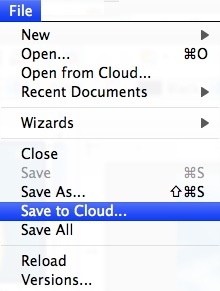
What’s wrong with this photograph?

Open Office

(Source – Jonathan Schwartz’s Blog.)

I posted an example of this picture(From a Sun MicroSystems Beta for OpenOffice) earlier in the Blog but saw it again yesterday and baulked. Fundamentally the picture misunderstands the cloud. Firstly it shows an application which is clearly based around a desktop computer installed with software – rather than software in the cloud… Secondly it suggests we would ever want to save away from the Cloud (Open/Save As)  – yes we might want to cache locally in case our connection failed but this should be handled for us – not by us!). Thirdly it suggests that we need to know what the cloud is.

Look at Google Apps for much better example of the future.

Google Sidewiki – Not available on Chrome

It is interesting that GOOGLE is trying to dominate in so many markets but seems not to be joined up (see Googled by Ken Auletta –http://www.amazon.com/Googled-End-World-As-Know/dp/1594202354). Its Chrome browser has been launched to try to wrestle control of the browser from IE (and FireFox) and provide usage data back to the Google corpus. Huge amounts were clearly spent on advertising in the UK – yet those developing it failed to include the very features Google have added to IE and Firefox – namely the toolbar. Having switched to Chrome I am left with even less Google-developed features than before. (e.g. try Google Sidewiki on Chrome).

Why is this important for the Cloud? Because the browser is the key access mechanism for Cloud services (particularly SaaS) and Google aims to be a key player in both providing the browser and providing the Cloud services. If its browser is problematic then its offering might be suspect.

Web Services and Cloud

I am currently in Korea at a Joint UK/Korean eScience workshop. One of the questions raised was that Web Services is a requisite for cloud – a precursor to the ability to move data-analysis jobs into the cloud. Similarly this rests on whether a problem can be effectively parallelised on CPUs with poor interconnects (since the networks in Cloud Providers are not the same as in a supercomputer). Unlike Grid or Clusters undertaking collaborative analysis using nodes on a cloud provider will require a more detailed understanding of the network infrastructure (and the virtual-machine distribution) of servers on the network.  This network issue should form part of the SLA when cloud services are commissioned.

One Big Namespace

One of the issues which seems to be missing from the debate is the nature of addressing. A key benefit of Grid and High-performance computing is the idea of global addressing of files and this seems a major drive forward for Cloud. Imagine if files are not locked to a server (i.e by a URL where the first part is a server – http://www.bbc.co.uk for example), but instead can reside anywhere and be addressed easily from anywhere. Why is this important? Because files live longer than the servers they reside on, and may not remain in the same place/country.

Publications on Cloud Computing research papers collection | Mendeley

Various Publications on Cloud Computing research papers collection | Mendeley.

Defogging the Cloud: Applying Fourth Amendment Principles to Evolving Privacy Expectations in Cloud Computing

David A. Couillard

The Economic Impact of Cloud Computing on Business Creation,Employment and Output in Europe

Federico Etro

A Break in the Clouds: Towards a Cloud Definition

Luis M. Vaquero1, Luis Rodero-Merino1 , Juan Caceres1, Maik Lindner2

  • This paper provides a useful table of definitions of Cloud from the literature (page 52), and most usefully a table comparing Grid and Cloud.

Haibo Yang, Mary Tate(2009) Where are we at with Cloud Computing?: A Descriptive Literature Review 20th Australasian Conference on Information Systems 2-4 Dec 2009, Melbourne

  • As a descriptive review of the literature on Cloud Computing within Information Systems this paper is necessarily limited. Little research has been done and hence the conclusions cannot be strong. That said it is a very useful piece with lots of material and a systematic analysis.

Relevant SaaS literature

Posted on the AIS World list; I have not reviewed them yet:

A Transaction Cost Perspective of the “Software as a Service” Business Model. By: Susarla, Anjana; Barua, Anitesh; Whinston, Andrew B.. Journal of Management Information Systems, Fall2009, Vol. 26 Issue 2, p205-240

Campbell-Kelly, M. “Historical Reflections The Rise, Fall, and Resurrection of Software as a Service,” Communications of the ACM (52:5) 2009, pp 28-30.

Choudhary, V. “Comparison of Software Quality Under Perpetual Licensing and Software as a Service,” Journal of Management Information Systems (24:2), Fall 2007, pp 141-165.