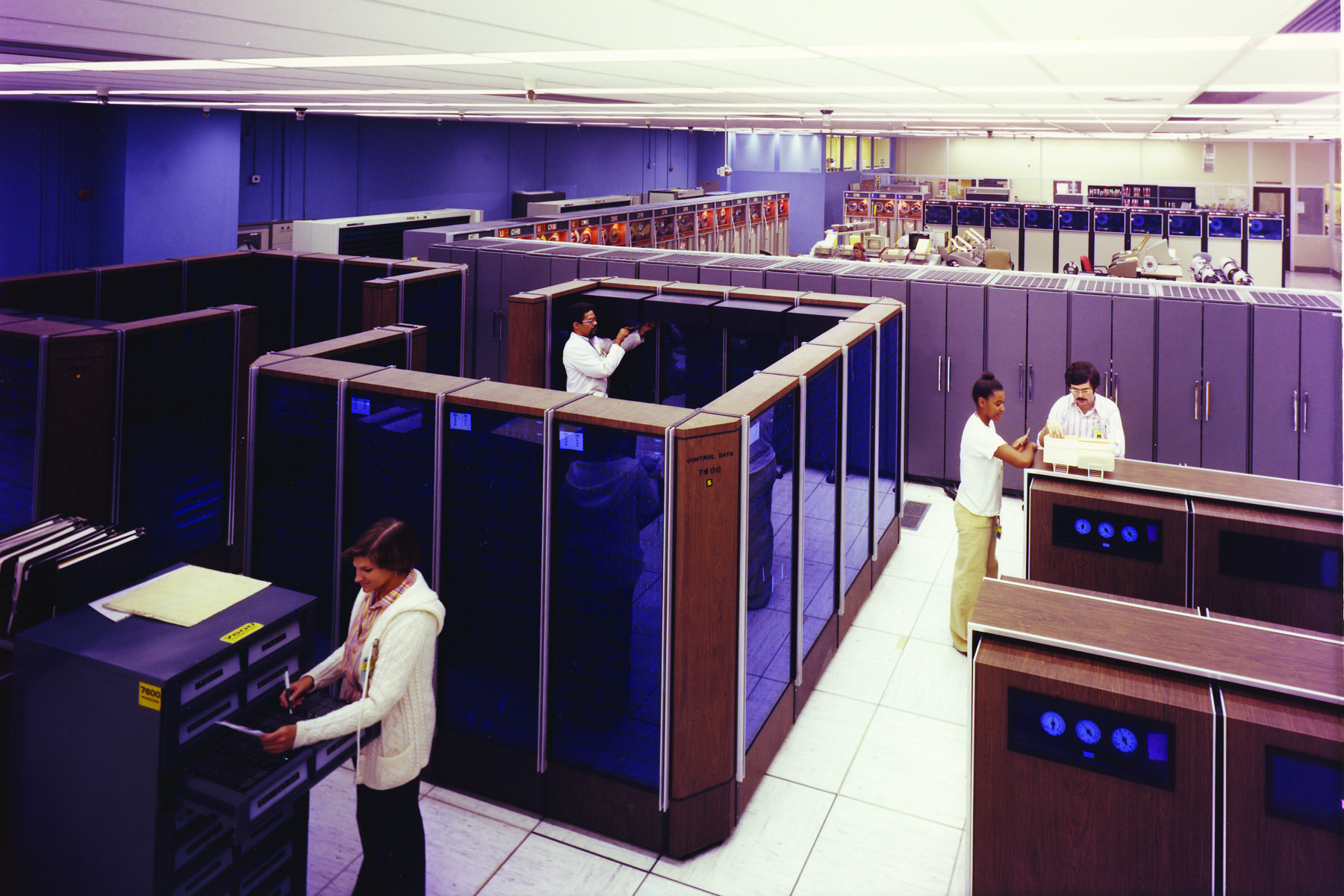
In the late 1960s computer programming changed drastically. Through the ’50s and ’60s programming was ‘off-line’ – undertaken by punching holds in punched-cards (see image), then batch processing stacks of these cards into the computer, waiting for results – often overnight – finding errors and repeating. It was painful and slow. Suddenly with new systems it was possible to programme online and interactively using time-sharing systems that had monitors and keyboards attached.
Research at the time showed that “online conditions resulted in substantially and, by and large, significantly better performance for debug man[sic]-hours than the offline conditions…” (Sackman et al 1968). The computer requirements to do this were substantial however programmers became considerably more productive – they could do much more programming work in a day.
Sound familiar? To me this is the same argument we are using today with the rise AI support for software development.
The question then is what happened next – did companies fire huge numbers of programmers who were no longer needed? No – the insatiable demand for new software, coupled with the increased productivity of developers, led more programmers to be hired to do more things. This has been the lesson of each increase in programmer productivity through time. Unless you believe CEOs are thinking ‘I’m done – I don’t need any new systems, any new software, any new service’ you should probably cease to worry as much about job losses and instead look at what the new skills are that are needed alongside AI programming tools. Because most companies have long lists of software they would like but that were previously too expensive to realise. Given this I believe that, over time, demand for those with software engineering expertise is still likely to grow. Not the same skills perhaps, but learning the basics of systems development, programming, and software engineering will certainly help whatever happens next.
Sackman, H., Erikson, W. J., & Grant, E. E. (1968). Exploratory experimental studies comparing online and offline programming performance. Commun. ACM, 11(1), 3–11. https://doi.org/10.1145/362851.362858
The following is the condolences article that Prof Edgar Whitley and I wrote about our colleague Frank Land who passed away last week aged 97.
In memory of Frank Land (1928-2026)
Frank Land, who has died aged 97, was a computer pioneer from the era of LEO (Lyons Electronic Office), the world’s first business computer. He was also one of the leading figures in shaping the intellectual and institutional foundations of Information Systems at LSE and internationally.
Frank and his twin brother Ralph were born in Berlin, Germany in 1928 but fled Nazi Germany in 1939 and came to the UK. After an undergraduate degree at LSE Frank joined J. Lyons and began work on LEO.
The entire LEO project was a pioneering one and was operating in uncharted territory, developing skills and clarifying issues that were not fully understood beforehand.
When Frank returned to LSE in 1967, he played a central role in creating the UK’s first academic programme in information systems. He drew on both his experiences with LEO and insights from the socio-technical approach first developed by the Tavistock Institute for Human Relations. Together, these shaped an approach to information systems that recognised that computers mattered, but so did the people using them – and the organisations they worked in.
Frank’s Information Systems group at the LSE launched a specialist MSc programme in the 1970s called MSc Analysis, Design and Management of Information Systems (ADMIS). The LSE continues to have a specialist MSc in Information Systems, now called MSc Management of Information Systems and Digital Innovation (MISDI). It also has a long-running and successful PhD programme, with over 200 PhDs awarded.
Many of the graduates from the PhD programme have since taken leading academic positions, ensuring that Frank’s influence can still be felt in lecture halls across the world. Some of Frank’s former students reflect on his influence below.
In 1998, Frank retired but remained active as a mentor and scholar, with publications appearing as recently as December 2025.
Frank’s achievements were recognised in many ways including an honorary Doctor of Science from what is now the University of East London. In 1992, he received the IFIP outstanding service award.
AIS, the Association for Information Systems, awarded him a fellowship in 2000 and, in 2003 the AIS LEO award for distinguished service to the discipline of information systems. In June, 2019 Frank was awarded an OBE in the Queen’s Birthday Honours List 2019 for services to the Information Systems Industry.
“There are so few individuals who have had the impact that Frank has had on the Information Systems field. He will be missed not only for his scholarship but for his sense of human kindness, respect for others, his undivided support for what is right, and all-around good nature. For those of us lucky enough to have had him as our thesis advisor, mentor, colleague and co-author we know there will never be another individual quite like Frank,” notes Rudy Hirschheim, now a Professor at Louisiana State University and one of Frank’s PhD students.
What recurs in all recollections is not just Frank’s scholarship but his character. As Tony Cornford, who first met Frank when he was a second-year undergraduate at LSE in 1972, put it: “I knew Frank for over 50 years, from the age of 19. He undoubtedly was the most influential mentor in my adult life. A beacon of sanity and 100% human being – not so common in academic life.”
Georgios Doukidis, whose first academic position was at LSE working with Frank and his wife Ailsa, a distinguished LSE Professor of Operational Research, notes: “Beyond remarkable achievements in Information Systems, Frank was known for his integrity, kindness and dedication to helping others. I am blessed to work both with Frank and Ailsa. Their legacy lives through their impressive scientific work and their values.”
Chrisanthi Avgerou, another of Frank’s students, writes: “Frank recognised that information technology mattered not only for firms’ success but also for society at large and national prosperity. With a UNESCO grant for students from developing countries, he introduced courses to build the skills they would need as information systems professionals in their home countries. He also fostered research on information systems in developing countries, pioneering the stream of research on IT and socio-economic development of the IS field”.
In the early to mid-1980s, when Bob Galliers, another of Frank’s students, was head of the School of Computing and Quantitative Studies at the Western Australian Institute of Technology’s Business School, he invited Frank to visit with a view to helping with the development and introduction of courses more associated with the organisational implications and management of IT. As a result of this reorientation, the name was changed to the School of Information Systems to more clearly distinguish it from that of Computer Science. Bob notes that: “Frank was one of a kind. There was not and will not be another like him. We shall forever miss him.”
Frank also played a leading role in developing the information systems field nationally and internationally. As Richard Welke recalls: “…before ICIS (and then AIS), there was IFIP TC8 and WG 8.2. Creating 8.2 was challenging as TC8 was largely dominated by very tech-oriented folks. Frank, Enid Mumford and Tim Lincoln were a few of the ‘English mafia’ that helped push for and succeed in getting 8.2 off the ground. IFIP 8.2 played a major role in creating the bridge between the US and European approaches to the information systems field.”
Later, when Frank learned that there were plans for two, European-focused, information systems conferences to be held at the same time, he helped ensure that rather than duplicating work, the two initiatives merged. The resulting event was the first European Conference on Information Systems (ECIS) in 1993. The 34th ECIS conference is taking place in Milan in 2026.
Frank was the co-founder of the Journal of Information Technology (JIT) in 1986 alongside Professor Igor Aleksander. In the first issue of JIT, Frank recalled Aleksander’s founding vision – that the Association for Information Technology should “primarily enhance communications between those involved with IT, whether they be users, computer scientists, consultants, teachers or industrial or commercial practitioners” – before adding his own view that this should include “whether they be engineers, accountants or social scientists, or whether they work in laboratories on the systems of the future, or work in offices with the systems of today.” That message remains as important today as it did forty years ago and continues to inspire the work of all who knew Frank. Igor Aleksander said: “We lose a person who was not only a leading intellect of this age, but one who defined the very nature of the computing character of this age.”
Frank’s inaugural professorial lecture at LSE “Information Technology: The Alvey Report and Government Strategy,” in 1983, was a prescient commentary on British IT policy. What made Frank’s contribution distinctive, Youngjin Yoo notes, was not just his conclusions but his willingness to read his moment honestly and respond to it – a quality he showed from his first days at LEO to his last lectures at LSE.
Frank remained supportive of students at LSE. Even in his final years, he took the time to lecture to MSc students about LEO. Every technology involved in that video presentation (the internet, video conferencing, portable computers) came into existence during his lifetime. Fundamentally connecting with his students and sharing ideas remained with him across all these changes.
Frank leaves behind a legacy that endures in the field he helped shape, the institution he served and the generations of students and scholars he inspired.
Edgar A. Whitley and Will Venters Department of Management, LSE
As part of the LSE’s Management Information Systems and Digital Innovation (MISDI) MSc I worked with Mark Chillingworth of diginomica to bring five digital leaders representing heavy industries, publishing, technology, advertising, and not-for-profit to speak with our students to share 12 key attributes the students will need in order to become a digital leader. Mark has written up the meeting for diginomica. Click on the link to check them out but the headline is that it is as much about people, change and leading – and asking the right questions. These are, thankfully, all things we focus on within the MISDI MSc! One nice quote from the article is:
“It is about being able to ask the good questions and be able to sense risk in operational gaps.You don’t need to know everything about coding or the architecture of the programme, but you do need to be able to make sure they cover all of the important things. Asking the right questions comes with practice and curiosity.”
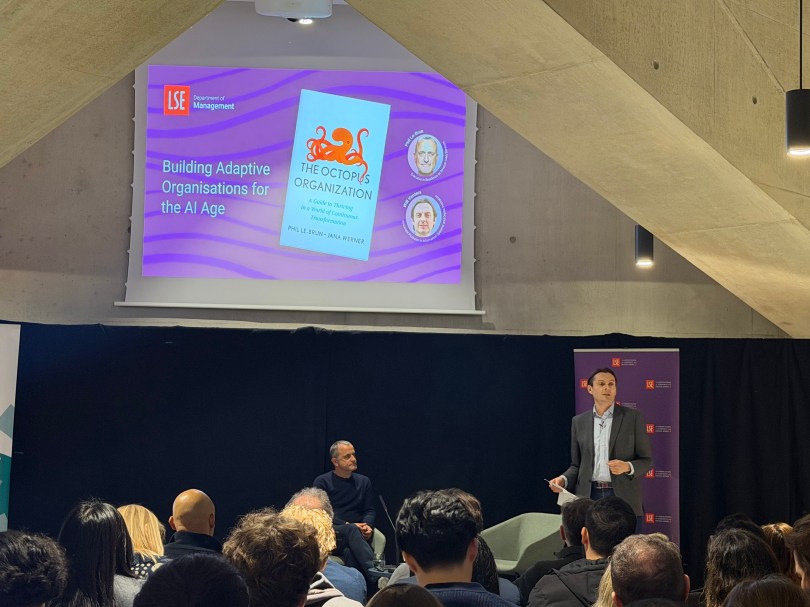
It was great to host Phil Le-Brun at the LSE last night – though sad to be his missing co-author Jana Werner. They were presenting their new book “The Octopus Organisation” https://www.theoctopusorganization.com/ which recounts a number of anti-patterns organisations must overcome to face the complexity of modern AI led business. Jana and Phil are both executives in residence at Amazon Web Services, part of a team of 15 people worldwide who advise fortune 500 executives on technology adaption, innovation and culture change.
We live in a time where AI technologies promise to transform work, yet few organizations are managing to gain the broad and deep impact of that promise. Here at the LSE last week, I heard Microsoft’s key AI Innovator talk about an “acceleration problem” in which, for most organisations, the future is arriving faster than forecast – and much faster than they can harness this “Intelligence as a Service”.
In the USA a couple of weeks ago, I heard NVIDIA’s VP for AI arguing that AI has a “systems problem” – AI is struggling to be embedded in organisational processes and systems. These views chime with emerging academic literature on the challenges of effectively introducing AI and Agentic AI into organisations.
Given that organisations themselves can be thought of as a form of artificial intelligence – social, collective, coordinated and intelligent structures responding to the world – it is time to ask if their culture, structure, leadership, R&D, and operations are ready for this artificial intelligence?
Are we at risk of just using AI to scale and increase inefficient bureaucracy we already have? I am thinking here about people who use GenAI to minute wholly unnecessary meetings, or use it to send ever more unnecessary emails? Are we at risk of creating, what our late LSE colleague Anthropologist David Graeber, might have termed “Bullshit AI Jobs”?
We discussed these and similar issues when Phil and Jana kindly consulted me in writing their book. They take a wholly different path and focus on preparing organisations and people for radical change like AI. Routed in deep thinking about people, technology and organisations, they focus on helping companies find ways to better adapt and learn. They don’t start with technology, they implore leaders to start with the organisation, and challenge what they describe as Antipatterns –the formulaic responses to complexity that, despite good intentions and surface-level appeal, consistently make things worse in all the companies they’ve studied.
Through interviews with executives in successful companies they have, as practitioners, sought to share how to overcome these antipatterns and build learning and adaptive organizations ready to address the challenges of AI today. Finally, it is a very practical book full of lessons and insight – and it’s already on my reading list for my students!
For the 19th edition of the iSCHANNEL the journal explores the dynamic intersection between emerging digital technologies and human behaviour, through rigorous and critical examination of how these reshape ethics, governance, and human agency. Reflecting the journal’s longstanding commitment to critical inquiry and contemporary research, this year the journal brings forth insightful articles that challenge the readers to continue questioning the assumptions embedded in digital infrastructures. Emphasizing the socio-technical nature of Information Systems (IS), this edition opens new areas of research in the field and bridges key knowledge gaps by developing theoretical and practical understandings based on the findings.
Embodying this year’s mission, Louis Bardet critically explores encrypted communication technologies and addresses the paradox of encryption, illicit actors, and legal frameworks. Positioned at the intersection between cybersecurity and governance, the article offers unique insights to privacy safeguards in encrypted communication and the need for regulatory approaches to ensure fundamental protections. Anna Hrytseniuk critically evaluates the role of Big Data Analytics on Supply Chain Agility and identifies how its efficiency and success comes from a balance of technological adoption and organisational adaptability. Linking Big Data and Learning Analytics within a higher education context, Florian Lüttgenau discusses through the micro-level, meso-level, and macro-level of audiences the need for integrated socio-technical approaches. Exploring the evolving ethics and responsibilities of AI-enabled lethal weapons, Nour Louhichi questions the accountability, responsibility, ethical dilemmas, and legislative role of governments in regulating such technology. Shifting the focus from warfare to misinformation, Yutong Shi highlights the threat posed by deep fake technology and its consequences in eroding public trust. To address this, the paper proposes practical governance frameworks and the need for improvement in current detection technologies. Integrating algorithmic bias and misinformation, Rosa Sooth proposes a critical literature review in the domains of economics, democracy, and public health. Notably, in the second contribution they analyse the role of transparency in such high-stake domains and the managerial trade-off that takes place. Emphasizing human-intelligent system collaboration, Amir Dotan critically explores how AI can be holistically embedded and proposes a socio-technical, macro-level perspective through Organisational Augmentation. Dahye Jung investigates the role of actors and power dynamics in digital platforms to critically evaluate existing literature on strategic partnerships between actors. Through a participatory design, Falka von-Niessen evaluates empirical evidence on the fairness of Online Labour Platforms in the gig work industry, highlighting the impact of AI interaction on labour fairness.
Finally, as the editorial team, we extend our gratitude to all writers, reviewers, and editors for this year’s iSCHANNEL. We also thank Dr. Will Venters, Lucy Lambe, and Yao Ma for their support and guidance in creating this issue.
About this journal
iSChannel is an annual journal on the social study of information systems which is produced, edited and double-blind reviewed by the students of the LSE Information Systems and Innovation programmes, with advice from faculty. As a core subject, our journal focuses on the study of ICTs, and the social implications of technological innovation. Still, research works from other perspectives are considered for publication, provided that they place the discussion on ICTs at the core of analysis and problematisation.
A pre-event, the 9th Dauphine Philosophy Workshop (DPW) “The Negative Ontologies of Time: Within or Beyond the Happening of Organizing?” will take place on 4 June at Université Paris-Dauphine, London Campus.
With keynote lectures by Santiago Espinosa, Mark Coeckelbergh and Mukulika Banerjee, panel discussions and over 20 parallel sessions, this event focuses on ontological and metaphysical discussions about organisations and organising in a digital era. The workshop is hosted annually by different universities around the world, and we are delighted to be welcoming you at LSE this year.
We’re hiring at the LSE for a 2 year Fellow position starting this September! Come work with Youngjin Yoo, Edgar Whitley, and many others in our leading group researching information systems and digital innovation.
LSE Fellow in Management (ISI)
LSE is committed to building a diverse, equitable and truly inclusive university
Department of Management
LSE Fellow in Management (Information Systems and Innovation)
Salary from £42,679 to £51,000 pa inclusive with potential to progress to £54,730 pa inclusive of London allowance
This is a fixed term appointment for two years and this post will commence on 1 September 2025
The Department of Management at LSE seeks to appoint outstanding candidates in the area of Management (Information Systems and Innovation). The department’s faculty and research strength is centred in Information Systems and Innovation, Employment Relations and Human Resource Management, Managerial Economics and Strategy, Marketing and Organisational Behaviour. The department’s faculty members are engaged in research and scholarly activity across LSE, through research centres such as the Centre for Economic Performance, the Behavioural Lab for Teaching and Research, and interdisciplinary institutes. The department’s own portfolio of degrees includes the BSc Management, one-year and two-year MSc in Management, and six specialist one-year MSc programmes.
The post holder will contribute to the Department’s teaching (postgraduate and/or undergraduate) and research activities in the discipline of Management (Information Systems and Innovation).
The successful applicants must have completed or be very close to completing by the post start date, a PhD in Management including Information Systems and Innovation. Applicants will have a very good knowledge of Management (Information Systems and Innovation) in their own specialism and breadth beyond that specialism. As well as a developing research record in well recognised peer reviewed outlets, you will be able to work in close partnerships with fellow teachers, including on a one-on-one basis and in small groups, and provide effective support as necessary, as well as having excellent communication and presentation skills.
We offer an occupational pension scheme, generous annual leave and excellent training and development opportunities.
To apply for this post, please go to www.jobs.lse.ac.uk. If you have any technical queries with applying on the online system, please use the “contact us” links at the bottom of the LSE Jobs page. Should you have any queries about the role, please email dom.facultyaffairs@lse.ac.uk.
The closing date for receipt of applications is Sunday 8 June 2025 (23.59 UK time). Regrettably, we are unable to accept any late applications.
While very last minute we would like to invite anyone interested in Interfaces, APIs, the API Economy and boundary resources role in Digital Innovations Ecosystems to come to a relaxed round-table event from 2pm-4pm on Saturday 14th December at the ICIS conference 2024 in Bangkok, Thailand. https://icis2024.aisconferences.org/
Keynote Speaker: Dr Ben Eaton – “From Interfaces to Innovation Ecosystems: Redefining Boundaries Through APIs“
Ben Eaton is an Associate Professor in the Department of Digitalization at Copenhagen Business School and adjunct Associate Professor at Høyskolen Kristiania, Oslo. Ben received the ACM SIGMIS Doctoral Dissertation Award for his PhD thesis in Information Systems, which he completed at the LSE. His research interests broadly concern innovation on and within digital platforms and digital infrastructures taking into account the dynamics between architecture, governance and installed base. His work has been published in journals including MIS Quarterly, the Journal of Information Technology, Information Systems Journal, the Journal of Strategic Information Systems, Government Information Quarterly, and MIS Quarterly Executive.
Workshop Aims:
The aim will be to build a community of interest and share ideas for research and foster potential collaborations. All welcome, however seats are limited so registration would be on a first come first serve basis. Please note that the workshop is free to attend and is supported by the IRIS project (Interface Reasoning for Interactive Systems) on the UK’s Engineering and Physical Sciences Research Council -EPSRC grant (EP/R006865/1). We will feed back some of the key research from this project.
The 2-hour workshop would begin with a keynote speech with time for Q&A, followed by two facilitated round table discussions on digital ecosystems and interfacing.
Participation and Sharing of early stage research is absolutely welcome! If you have any ideas and would want to do something within the 2hrs, do let us know!
Key literature includes –
Gupta, A., Panagiotopoulos, P., & Bowen, F. (2023). Developing capabilities in smart city ecosystems: A multi-level approach. Organization Studies, 44(10), 1703-1724.
Pujadas, R., Valderrama, E., & Venters, W. (2024). The value and structuring role of web APIs in digital innovation ecosystems: The case of the online travel ecosystem. Research Policy, 53(2), 104931.
Wang, P. (2021). Connecting the parts with the whole: Toward an information ecology theory of digital innovation ecosystems. MIS quarterly, 45(1).
If you want to participate/ present your research/attend/ help with organisation of workshop, please feel free to contact Anushri Gupta (a.gupta140@lse.ac.uk) or Will Venters (w.venters@lse.ac.uk).
Looking forward to seeing you and engaging with the community at ICIS soon! 🙂
The CFP of the 15th OAP Workshop is out! This year’s theme: “Ordinary Democracy in the Making: Renewing Our Times and Spaces of Democratic Representation in and through Organization”.
One theme I am personally particularly keen to see explored in the conference is governance arrangements for digital infrastructure and how “democratic” they are (or are not).
Even with two new people just starting as asssitant professors we are contining to recruit to our group! Please circulate!
JOB ADVERT TEXT:
Assistant Professor in Management (Information Systems and Innovation)
LSE is committed to building a diverse, equitable and truly inclusive university
For this post, we welcome applications from women and people from minority ethnic groups
Department of Management
Assistant Professor in Management
(Information Systems and Innovation)
Salary is competitive with Departments at our peer institutions worldwide.
Salary is no less than £61,466 per annum, the salary scale can be found on the LSE website
In addition this post will attract a significant market salary supplement which reflects current market conditions.
The Department of Management plays a central role in the LSE, a global, single-faculty, social science university located in the heart of London. The Department is organised into faculty groups of information systems and innovation; employment relations and human resource management; operations management; managerial economics and strategy; organisational behaviour; and marketing. The Department’s faculty are engaged in research and scholarly activity within their faculty groups and across LSE in research centres such as the Data Science Institute and other interdisciplinary institutes. The Department’s degree portfolio includes the BSc Management, a two-year Master’s in Management, and a number of specialist one-year Master’s programmes, including the MSc Management of Information Systems and Digital Innovation (MISDI).
The Department of Management at LSE seeks to hire an outstanding Assistant Professor belonging to the Information Systems and Innovation (ISI) group. The post holder will contribute to the intellectual life of the School by conducting and publishing outstanding quality research, engaging in high quality teaching as instructed by the Head of Department, and participating in School and Department activities.
In recruiting for this position, the LSE intends to build on the ISI group’s distinctive socio-technical approach to research and education by adding depth specifically in emerging digital innovations. All members of ISI faculty are expected to contribute to our flagship degree, MSc MISDI. We will prioritise applications that show good understanding of our teaching programme and research tradition.
Successful applicants will have a PhD or be close to completing a PhD in a social science discipline and/or an interdisciplinary field relevant to Management (Information Systems and Innovation). A track record of internationally excellent publications, or a trajectory for achieving this, as well as a well-developed strategy for future outstanding socio-technical research in information systems and innovation that has the potential to result in world-leading publications is essential. We also require a demonstrable ability to teach on undergraduate and postgraduate programmes.
The other criteria that will be used when shortlisting for this post can be found on the person specification attached to this vacancy on LSE’s online recruitment system.
In addition to a competitive salary the rewards that come with this job include an occupational pension scheme, research incentive scheme with personal reward options, generous research leave (sabbatical) entitlement, collegial faculty environment and excellent training and development opportunities.
To apply for this post, please go to www.jobs.lse.ac.uk. If you have any technical queries with applying on the online system, please use the “contact us” links at the bottom of the LSE Jobs page. For queries about the role contact: dom.facultyaffairs@lse.ac.uk
The closing date for receipt of applications is Sunday 20 October 2024 (23.59 GMT). We are unable to accept any late applications.