[Academic Call]: AI and the Artificialities of Intelligence.

I am really excited to be a co-chair of the following academic workshop at ESSEC & Université Paris Dauphine-PSL. Please join us if you can!

AI and the Artificialities of Intelligence: What matters in and for organizing?

Call for papers 14th Organizations, Artifacts & Practices (OAP) Workshop #OAP2024

When: June 6th and 7th 2024

Where: Paris (ESSEC & Université Paris Dauphine-PSL). Face-to-face event.

Co-chairs:

Ella Hafermalz (Vrije Universiteit Amsterdam)  François-Xavier de Vaujany (Université Paris Dauphine-PSL)    Aurélie Leclercq-Vandelannoitte (CNRS, LEM, IESEG, Univ. Lille)
Julien Malaurent (ESSEC)Will Venters (LSE)Youngjin Yoo (Case Western University)

This 14th OAP workshop jointly organized by Université Paris Dauphine-PSL (DRM), ESSEC and ESSEC Metalab will be an opportunity to come back to the issue of Artificial Intelligence and its relationship with the history, philosophy and politics of management and organization.

Artificial Intelligence now pervades discussions about the future of organizations and societies. AI is expected to bring deep changes in work practices and our ways of living. Utopian and dystopian narratives are abundant. However, AI is far from being a fleeting trend; rather, it constitutes a collection of techniques with a rich history dating back to the 1950s. AI serves as a broad framework deeply intertwined with ideals of rationalism and representationalism – much like the broader digital landscape it epitomizes. The aspiration in the realm of AI is that self-sufficient techniques will progressively and continuously enhance our comprehension of the world. By means of rules and the use of massive amounts of data, it is expected that learning capabilities make AI tools more and more likely to expose and elucidate the underlying realities of the processes they initially are designed to represent. Increasingly, AI transcends its role as a ‘unraveller’ of complexity in the present. It discloses our future, what will happen in the next seconds, days, month, years or centuries. It arguably encompasses the entirety of our potential futures.

As well as having a certain hold on our future(s), these powerful tools are impacting how we think. Our cognition and understanding of the world are dramatically extended, amplified, revolutionized, but also individualized, siloed, and cut off from traditional social processes of interaction and sensemaking. In this vein, the gap between our ways of acting (in an embodied way) and our ways of thinking, grows. The dualism at the heart of representationalism, although more and more visual, narrative and corporeal, become central and even foundational. Part of our cognition – and our social practice of gaining and sharing knowledge – is delegated to AI.

These artificialities of intelligence (in particular collective intelligence), will be at the heart of this 14th OAP workshop in Paris. Behind and beyond AI as a set of codes, norms, standards, and massive use of data, our intelligence is more and more artificialized. Our collective intelligence relies on a representationalist philosophy which starts from a problem (a request) submitted to Bard or Chat GPT, generative AI tools, offering then a relevant narrative likely to answer brilliantly and confidently. Co-problematization, inquiry, concerns, openness, in short, life, are not at all part of this equation. This artificial organizing process will be central in  our discussions.

In particular, we welcome abstracts likely to cover the following topics:

  • Artificialities of intelligence as organization and organizationality;
  • Historical perspectives on digitality and AI;
  • Historical perspectives on calculative techniques, cybernetics, AI and digitality in general, in relationship with management and organizationality;
  • Revisiting and problematizing traditional assumptions about knowledge sharing and communities of practice;
  • Ethnographies, collaborative ethnographies and auto-ethnographies about AI in organizations ;
  • Pragmatist inquiries about collective intelligence;
  • Critiques of cognitivism in organization studies and management, e.g., strategic management, accounting, marketing, logistics and MIS;
  • Explorations of the relationships between new managerial techniques and AI;
  • Temporal and spatial views about AI and artificialities of intelligence;
  • Phenomenological and post-phenomenological perspectives about AI in organizations;
  • Process perspectives on the artificiality of intelligence;
  • Critical views of AI and the artificialities of intelligence;
  • AI and the metamorphosis of scientific practices;
  • AI the dynamic of scientific communities and scientific paradigms;
  • AI and its political dimension in organizations.

Of course, our event will also be opened to more traditional OAP ontological discussions around the time, space, place and materiality of organizing in a digital era, e.g., papers discussing ontologies, sociomateriality, affordances, spacing, emplacement, atmosphere, events, becoming, practices, flows, moments, existentiality, verticality, instants in the context of our digital world.

Please note that OAP 2024 will include a pre-event, the Dauphine Philosophy Workshop also hosted by University Paris Dauphine-PSL on June 6th 2024 and entitled: “Beyond judgement and legitimation: reconceptualizing the ontology of institutional dynamics in MOS”.

Those interested in our pre-OAP event and our OAP workshop must submit an extended abstract of no more than 1,000 words to workshopoap@gmail.com. The abstract must outline the applicant’s proposed contribution to the workshop. The proposal must be in .doc/.docx/.rtf format and should contain the author’s/authors’ names as well as their institutional affiliations, email address(es), and postal address(es). Deadline for submissions will be February 3rd, 2024 (midnight CET).

Authors will be notified of the committee’s decision by February 28th, 2024.

Please note that OAP 2024 will take place only onsite this year.

There are no fees associated with attending this workshop.

Organizing committee: Hélène Bussy-Socrate (PSB), François-Xavier de Vaujany (Université Paris Dauphine-PSL, DRM), Albane Grandazzi (GEM), Aurélie Leclercq-Vandelannoitte (CNRS, LEM, IESEG, Univ. Lille), Sébastien Lorenzini (Université Paris Dauphine-PSL, DRM) and Julien Mallaurent (ESSEC).

REFERENCES

Aspray, W. (1994). The history of computing within the history of information technology. History and Technology, an International Journal, 11(1), 7-19.

Berente, N., Gu, B., Recker, J., & Santhanam, R. (2021). Managing artificial intelligence. MIS quarterly, 45(3).

Chia, R. (1995). From modern to postmodern organizational analysis. Organization studies, 16(4), 579-604.

Chia, R. (2002). Essai: Time, duration and simultaneity: Rethinking process and change in organizational analysis. Organization Studies, 23(6), 863-868.

Clemson, B. (1991). Cybernetics: A new management tool (Vol. 4). CRC Press.

de Vaujany, F. X., & Mitev, N. (2017). The post-Macy paradox, information management and organising: Good intentions and a road to hell?. Culture and Organization, 23(5), 379-407.

de Vaujany, FX. (2022). Apocalypse managériale, Paris : Les Belles Lettres.

Introna, L. D., & Introna, L. D. (1997). Management: and manus. Management, Information and Power: A narrative of the involved manager, 82-117.

Nascimento, A. M., da Cunha, M. A. V. C., de Souza Meirelles, F., Scornavacca Jr, E., & De Melo, V. V. (2018). A Literature Analysis of Research on Artificial Intelligence in Management Information System (MIS). In AMCIS.

Öztürk, D. (2021). What Does Artificial Intelligence Mean for Organizations? A Systematic Review of Organization Studies Research and a Way Forward. The Impact of Artificial Intelligence on Governance, Economics and Finance, Volume I, 265-289.

Pickering, A. (2002). Cybernetics and the mangle: Ashby, Beer and Pask. Social studies of science, 32(3), 413-437.

Lorino, P. (2018). Pragmatism and organization studies. Oxford University Press.

Simpson, B., & Revsbæk, L. (Eds.). (2022). Doing Process Research in Organizations: Noticing Differently. Oxford University Press.

Thompson, N. A., & Byrne, O. (2022). Imagining futures: Theorizing the practical knowledge of future-making. Organization Studies, 43(2), 247-268.

Vesa, M., & Tienari, J. (2022). Artificial intelligence and rationalized unaccountability: Ideology of the elites?. Organization, 29(6), 1133-1145.

Wagner, G., Lukyanenko, R., & Paré, G. (2022). Artificial intelligence and the conduct of literature reviews. Journal of Information Technology, 37(2), 209-226.

Yates, J. (1993). Control through communication: The rise of system in American management (Vol. 6). JHU Press.


Academic Colloquium: LSE Information Systems and Innovation Group

For the academics reading this blog it would be wonderful to see you at the following which the IRIS research project is sponsoring:

Research Colloquium on Digitalization and its Impacts

The Information Systems and Innovation Group within the Department of Management at the London School of Economics is pleased to announce a Colloquium on Digitalization and its Impacts which will be held on LSE campus in London on the 7th of June 2023. The Colloquium is an opportunity for IS researchers, at any level of experience and seniority, to discuss research related to key and emerging themes surrounding Digitalization in a constructive setting. 

The Colloquium will include research talks from noted IS scholars representing a range of different genres as well as discussions on the nature of Digitalization, and the opportunities and challenges it creates for business and society. 

Speakers include the following: 

Monideepa Tarafdar, University of Massachusetts Amherst 

Roberta Bernardi, University of Bristol 

Stefan Seidel, University of Cologne 

Philipp Hukal, Copenhagen Business School 

Emmanuelle Vaast, McGill University  

Full details of the agenda, as well as abstracts of the talks, will be provided closer to the date. 

The colloquium will be held in-person and we invite IS scholars to join us.  Attendance is free of charge (though attendees will have to cover their own travel and lodging costs). For administrative reasons, registration to the colloquium is required. Please click on the link below to complete your registration, no later than 31st May, 2023. 

 If you have any questions, do not hesitate to contact us at ISIGevent@gmail.com

We are looking forward to seeing you in June! 

Colloquium organizers:  

Chrisanthi Avgerou, Saonee Sarker, Susan Scott 

This event is sponsored by the EPSRC-funded project Interface Reasoning for Interacting Systems (IRIS) – EP/R006865/1. 

CIOs keen to drive consequential-innovation

A couple of weeks ago I chaired a Global CIO Institute conference, hosting a dinner, various talks, and round table discussions with CIOs.

What has struck me during all these interactions was the marked contrast between these CIOs at the coalface and the topics obsessed upon by LinkedIn/academic/journalistic style discussions. While CIOs are interested in topics like digital transformation, AI, robotics, data-lakes and lakehouses, the API-economy and the rise of ChatGPT (the usual LinkedIn fare) these were not what drove them. Their interest was much more on safely driving consequential innovation within their company’s line of business.

Of significant interest within this was the need to manage various forms of risk. Risk was not to be “avoided” – or as Robin Smith (CISO) at Aston Martin put it, we need to promote “positive risk taking” for innovation. All intervention generated risk. For some this manifested as needing guard-rails around IT innovation so creative and innovative staff were not constrained by the risk of a catastrophic failure. This was particularly true as low-code and citizen development expands. For CIOs, developing a culture of innovation demanded systems that allowed innovations to fail safely and elegantly.

Risk-taking behaviour within innovation was only one risk they face. Sobering conversations concerned external sources of risk and the need for business resilience in the face of pandemic, war, and cyber-security challenges. Any innovation in digital technology increases the potential surface-area that companies can be attacked through. This demands ever more sophisticated (and expensive) technical countermeasures but also cultural changes. While attention is driven towards the use of AI (like ChatGPT) for good, nefarious actors are thinking about how such tools might be used for ill. For example, attackers can use emails, telephone calls, and deep-fake video calls to sound, and even look, like a company’s CEO or top customer asking for help[1]. How can CIOs ensure their staff do not fall foul of these and various more technical scams? How can trust be established if identity is hard to prove? What happens when AI is applied to exploring possible attacks through Public APIs?

Also of significant concern was keeping-the-lights-on with their ever more demanding and heterogenous estate of products, platforms and systems. One speaker pointed out the following XKCD cartoon which captures this so well. The law of unintended consequences dominated many of their fears, particularly as organisations moved towards exploiting such new-technologies in various forms.  

 Source/: https://xkcd.com/2347/ (cc) XKCD with thanks).

What was clear, and remains clear, is that we need to have a view of the enterprise technology landscape that balances risk and reward. While commentators ignore the complexity of legacy infrastructure, burgeoning bloated cloud computing estates, and the risks involved in adding more complexity to these, those tasked with managing the enterprise IT estate cannot. 

These thoughts are obviously not scientific and are entirely anecdotal. The CIOs I met were often selected to attend, the conversations were steered by agenda etc. But they did remind me why CIOs are not as obsessed with ChatGPT as everyone might think.


[1] An executive from OKTA gave the example of this for Binance exec says scammers made a deep fake hologram of him • The Register

Header Image “Business Idea” by danielfoster437 is licensed under CC BY-NC-SA 2.0.

Recruitment: LSE Fellow in Management (Information Systems and Innovation)

Come join our group of Information Systems Researchers for a year: LSE Advert copied below.

LSE is committed to building a diverse, equitable and truly inclusive university

Department of Management

LSE Fellow in Management (Information Systems and Innovation)

Salary from £36,647 to £44,140 pa inclusive with potential to progress to £47,456 pa inclusive of London allowance

This is a fixed term appointment for one year

The Department of Management at LSE seeks to appoint an outstanding candidate in the area of Management – Information Systems and Innovation. The department’s faculty and research strength is centred in Employment Relations and Human Resource Management, Information Systems and innovation, Managerial Economics and Strategy, Marketing, Organisational Behaviour and Operations Management. The department’s faculty members are engaged in research and scholarly activity across LSE, through research centres such as the Centre for Economic Performance, the Behavioural Research Lab, and interdisciplinary institutes.  The department’s own portfolio of degrees includes the BSc Management, one-year and two-year MSc in Management, and six specialist one-year MSc programmes. 

The post holder will contribute to the Department’s teaching (postgraduate and/or undergraduate) and research activities in the discipline of Management – Information Systems and Innovation.

The successful applicants must have completed or be very close to completing by the post start date, a PhD in the area of Management including Information Systems and Innovation or a discipline relevant to the post.  A developing research record in well recognised peer reviewed outlets, and a clear and viable strategy for future research in the field of Management – Information Systems and Innovation is essential; as is relevant teaching experience and excellent communication and presentation skills.

For further information about the post, please see the how to apply documentjob description and the person specification.

We offer an occupational pension scheme, generous annual leave and excellent training and development opportunities.


If you have any technical queries with applying on the online system, please use the “contact us” links at the bottom of the LSE Jobs page. Should you have any queries about the role, please email dom.facultyaffairs@lse.ac.uk.

The closing date for receipt of applications is 8 August 2021 (23.59 UK time). Regrettably, we are unable to accept any late applications.

An LSE Fellowship is intended to be an entry route to an academic career and is deemed by the School to be a career development position.  As such, applicants who have already been employed as a LSE Fellow for three years in total are not eligible to apply. If you have any queries about this please contact the HR Division.

I’m recruiting: Research officer in Information Systems and Innovation (IRIS Project)

We’re recruiting for the IRIS research team at the LSE!

Research Officer in Information Systems and Innovation (lse.ac.uk)

The post holder will work on the EPSRC funded project: Interface, Reasoning for Interacting Systems (IRIS). The IRIS project is a collaboration between University College London, Imperial College of Science, Technology and Medicine, Queen Mary, University of London, and the London School of Economics and Political Science.

The successful candidate will manage all stages of the research process. This will include coordination of data gathering; research production; dissemination and communication of research findings; demonstrating the impact of the research; and contributing to applications for further research funding.  The post holder will co-author outputs for the projects and will likely co-author the academic papers.

Candidates should have expertise and research interests in Information Systems and Innovation.

A completed PhD, or close to obtaining a PhD, in Information Systems or a relevant related field by the post start date. Proven ability or potential to publish in internationally excellent publications; and experience in qualitative research method skills.

For further information about the post, please see the how to apply documentjob description and the person specification.

 If you have any technical queries with applying on the online system, please use the “contact us” links at the bottom of the LSE Jobs page. Should you have any queries about the role, please email W.Venters@lse.ac.uk  

The closing date for receipt of applications is 7 June 2021 (23.59 UK time). Regrettably, we are unable to accept any late applications.

DIIESL Seminar Series – Innovation in the interface economy – APIs, business value and ecosystems

DIIESL

Please join us for the next seminar in the DIIESL Seminar Series to be held online on Thursday 28th May 2021, details below.

DIIESL Seminar Series

Innovation in the interface economy – APIs, business values and ecosystems

Thursday 27th May 2021 

3.00 – 5.00pm (British Summer Time = GMT+1)

This is an online seminar, please click to register

Application Program Interfaces (APIs) arguably sit at the heart of innovating in this digital era. They allow the integration of cloud services, enable containerised applications (e.g. via Docker) to operate in new ways within Cloud environments, allow developers of all levels to innovate new services quickly and at low cost, and enable new business models such as product platforms and service ecosystems. For example, the explosion of AI technologies is, to a significant degree, enabled by APIs connecting cloud-based Machine Learning ‘Lego’ bricks to create ever new services at the point of need. In this way APIs are underpinning ‘combinatorial innovation’ (Yoo, Boland et al. 2012) of the modern cloud-based world.

Our third DIIESL seminar will bring together insights from academics working on Interfaces, APIs, modularity, and innovation.

Chairperson: Dr Will Venters, LSE

Speakers: 

Prof Nigel P MelvilleUniversity of Michigan, “Generating Business Value from Machine Interfaces: Models of Efficiency, Focus, & Transformation.

Dr Roser Pujadas, LSE, The role of interfaces in fostering digital ecosystems: A study of the online travel service ecosystem”.

Prof Hans Berends, KIN, Vrije Universiteit Amsterdam, Innovation ecosystems and systems of use: the role of intermediary platforms and users in creating complementary value.

For abstracts and speaker bios and for more information about DIIESL’s forthcoming and past seminars, please visit www.diiesl.org

(Image by Denny Müller on Unsplash)

LSE Sprint Week – in Covid times.

On this last day of term I thought I would take a moment to reflect on the online teaching of “Innovating Organisational Information Technology” at the LSE with Carsten Sorensen and, in particular, the hugely popular LSE Sprint Week; a week long sprint following Jake Knapp’s influential sprint book which I organise and run.

Old Sprint Weeks

Usually this involves ~100 students working together in a huge hall around tables and whiteboards (see left). But this year, with only a couple of weeks notice, I had to move this entirely online. 110+ students, 21 parallel Sprints, various technical and administrative challenges, a real-world business problem, and world-class consultants judging on Friday afternoon. All online.

The week starts with a presentation from VISA of a significant challenge our students must address: this year it was various scenarios of fraud using the fast-payment infrastructure. Having received the challenge I released the my pre-prepared MURAL.co templates for each group to follow. The templates set out exactly what each group needed to do each day and were vital to ensuring groups could self-manage the week. Mural is a whiteboarding solution allowing you to zoom right into tiny post-it notes or images (see below). The groups would then use the templates adding their work collaboratively during the week and submitting their design via the red box on Fridays template. The template contain everything the groups needed including templates, instructions and forms.

The template was thus designed to be followed without outside facilitation by faculty and with each student in each group taking the role of group-facilitator for one of the days. In addition, dice were thrown to see who would be the “Decider” in the group – the group-CEO who could be called upon to make any tricky decision. Dice work well for this – ensuring the role is not always allocated to the loudest and most confident in the group.

One useful feature of MURAL is the ability to create rooms for shared collaboration around whiteboards. I therefore created seven rooms and clustered the groups into these allowing them to each see two other groups Mural-whiteboards. Clusters allowed groups to compare, discuss and peer-review each others work, and reduced the stress on groups as they could see how two other groups were struggling or overcoming the challenges and ask them questions. It also increased drastically social interaction among students. Each day Carsten and I met with each cluster for 30minutes – providing feedback and answering questions. This was important as it allows us to review each group quickly and maximise the time we had. Zoom was used for these meetings. We also held short “All-Hands” meetings every morning to share learning with the whole 110 students.

Outside speakers are major part of the Sprint Week and we were delighted to have Jake Knapp himself join us on two days to present and answer questions. This proved important as it reinforced that, despite not having a face to face sprint week, this was just as intense, innovative and important an experience for our students. This message was reinforced by VISA’s innovation team who have used Mural.co all this year, and by Roland Berger’s Spielfeld Digital Hub GmbH team who joined later in the week. Thanks to sponsorship from Roland Berger we could provide students with a copy of the book as well! [Jake is 4 along, 2, down, myself 2,1, Carsten 4,1].

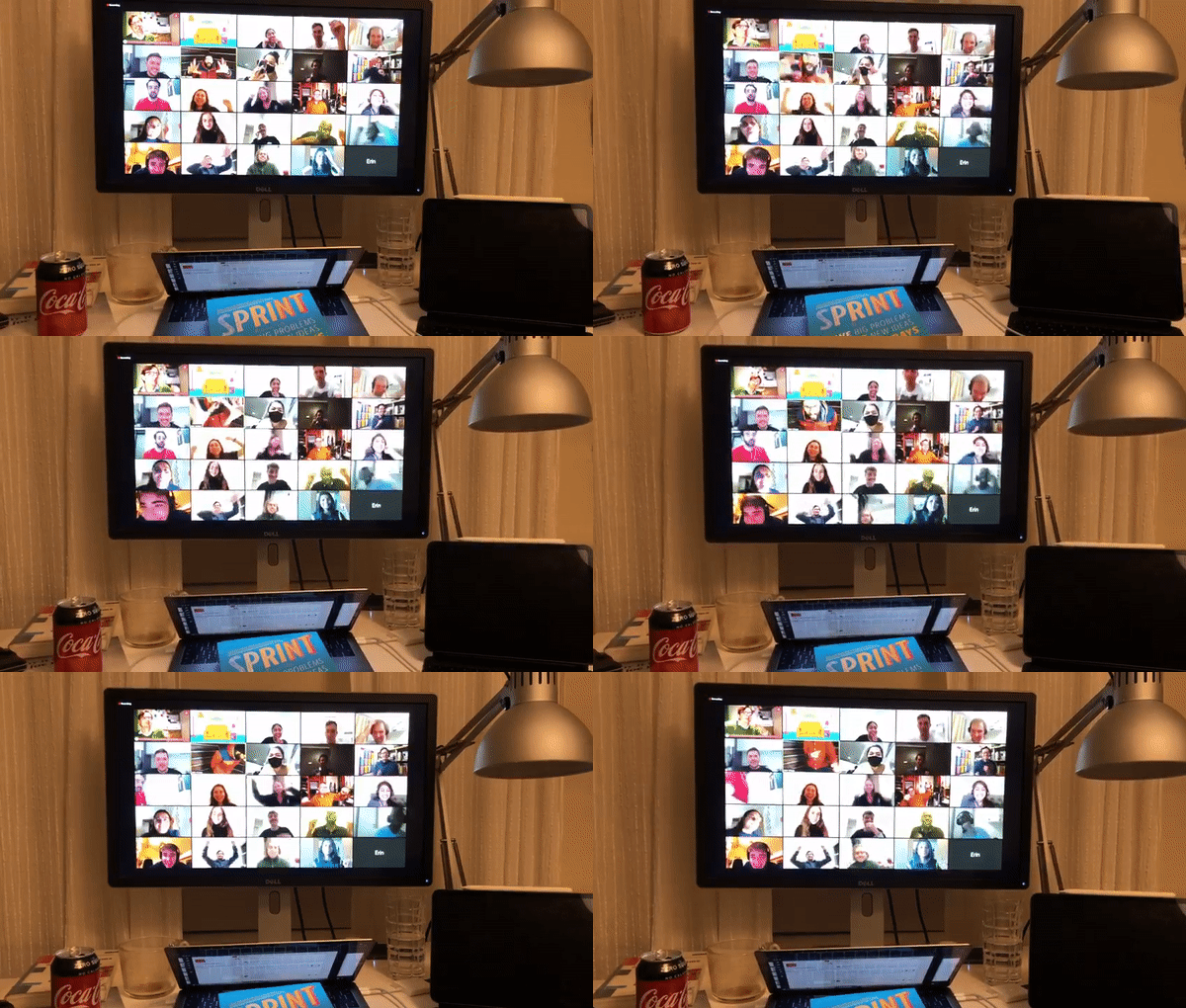
Jake proved amazing at lightening the mood and helping the students realise that online sprints are certainly possible, and can easily be useful, innovative and fun – reinforced by organising a zoom dance session.

Scheduling

With so many moving parts during the week scheduling was vital. Outlook calendar proved the best tool available for this. Sharing my calendar with my admin support, and sending meeting invitations to all the students, either on-mass or in their clusters, allowed us to schedule the whole week. This also allowed dynamic changes during the week to be shared quickly with everyone and, crucially, handled time-zone challenges for those working overseas (though many of these students had decided to shift their body-clock for the week and so worked nights). Below is the final schedule for the week. Notice that during Wednesday and Thursday we had sessions where Roland Berger consultants mentored each group. This consultant feedback, (including from some who were our Alumni), was vital as it give industry-relevant feedback and reassured groups that the skills they were gaining were relevant to industry today! Finally we bought a cheap mobile phone and through this provided a WhatsApp, WeChat, Voice and Email helpdesk (manned by Dr Boyi Li) throughout the week.

Evaluation

During a face-to-face sprint it is easy to gauge the mood of the teams and adjust the week accordingly – indeed this is one of the key skills of a facilitator. But for twenty-one online parallel groups this was impossible. As such I devised a daily “check-in” form using Microsoft Forms which each student needed to complete nightly and which I reviewed each morning. This was helpful in showing minor points for improvement, and also extremely satisfying to see the overall rating for the the week:

Marking:

The students received two forms of feedback for Sprint Week. The first was on Friday when I invited industry experts (from Visa and Roland Berger, PA Consulting, Government and Salesforce) to form a “Dragon’s Den” to watch the video pitches each group had prepared and judge the winners based on innovativeness of the pitch. This was a wonderful experience for groups and unveiled the “winners” of sprint week – who will go forward to present their ideas to VISA’s innovation labs next year.

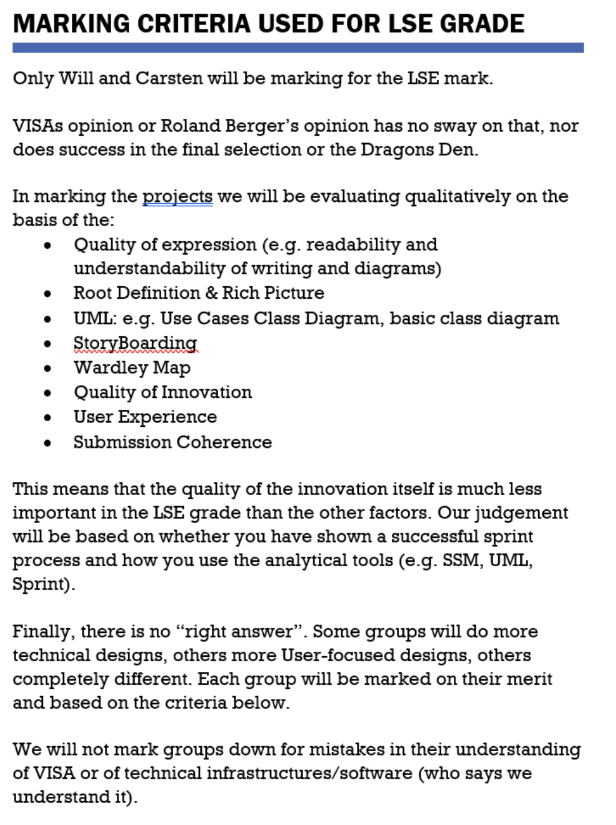
This was not however the judgement of academic success, and after Sprint Week Carsten and I carefully marked each groups project based on the following criteria (listed on each groups MURAL) for their academic grade:

Having an academic grade for Sprint Week has been important in ensuring groups feel the stress of caring about their design. Each group then received a feedback form with a few paragraphs explaining the rational for the marks and outlining any limitations in their design – thus ensuring they learnt from the entire experience.

Teamwork support

Before the week started teams were encouraged to organise a meeting and use the Team Canvas to understand their working practices and plan the week. I also held a 1hr introduction to Mural so the students would know how to use the tool effectively prior to Sprint Week.

Video Conferencing equipment:

Finally I was also lucky enough to have very good quality equipment to run Sprint Week . I used an ATEM Mini Pro video switcher and my own good camera and microphones for meetings. These tools proved invaluable during the teaching as, within zoom calls, I could add overlays with information (e.g. lower-third messages about the day) and professionally switch between devices (e.g. my video camera, an overhead camera for drawing/whiteboarding, images, my tablet as a white-board, even my phone to show a Time Timer app). During meetings for example I could put my phone as a timer in the corner of my Zoom video images to keep students to time. This technology, while expensive and complex to use, improved the professionalism of my teaching this term and, perhaps, along with the work above, helped reassured students that they were still receiving an LSE quality sprint experience online.

My “Lecture Theatre” during Sprint Week! (the tin foil on the window was to stop the camera overheating in the sun)

Recruiting: LSE Information Systems and Innovation Group – Associate and Assistant Professor levels.

Fancy joining the LSE Information Systems and Innovation Group? We are recruiting an Associate Professor and Assistant Professor. Adverts below.

Any questions about this then Susan Scott is the best first contact! 

https://jobs.lse.ac.uk/Vacancies/W/3493/0/283924/15539/assistant-professor-in-management-information-systems

https://jobs.lse.ac.uk/Vacancies/W/2117/0/283916/15539/associate-professor-in-management-information-systems

Photo by Clem Onojeghuo on Unsplash

E-Governments and Governing in the Digital Age: Diiesl.org Seminar next week.

I am pleased to promote the following seminar (part of the Diiesl.org seminar series):

Online Seminar – to register your attendance please click here

Tuesday 24th November 2020

2.003:00-5.00pm (GMT) (note change of time!)

Governments and international organizations have increasingly been adopting digital technologies in the provision of public services in the last decades. The opportunities provided by digital innovations have hugely impacted the way the public sector has been transformed. E-government has been increasingly studied as a way to reach goals of efficiency, production and participation. Despite these improvements, governments seem to be struggling to make sense of the opportunities and challenges provided by digital technologies; they have been blamed for poor governance practices, discarding stakeholder concerns, and failing to consider the social implications of relying on digital technologies. 

With public sectors worldwide likely to be more than ever dependent on technology, there is a need for a nuanced account of how digital technologies impact on the provision of public services, and on the economic, political and social consequences that can result from this. 

In this workshop, we would like to reflect on e-government and governing in the digital age. Topics for discussion include: 

· E-government and the opportunities of digital technologies and platforms for public sectors 

· The potential social implications of implementing digital technologies and the role of policymakers 

· Accountability in the digital age: how to deal with risk, trust, participation and the production of value 

Chairperson: Dr Wendy Günther 

Speakers 

Dr Beth Kewell – Exeter Business School (INDEX): “UKRI Funding for Blockchain Research: Directions of Travel (Both Real and Imagined)” 

Dr Francesco Gualdi – London School of Economics: “Law, technology and policies: a complex negotiation to generate value”. 

Prof Rony Medaglia – Copenhagen Business School: “AI adoption in the public sector: opportunities and challenges”

iSChannel Journal 2020 – 15th year anniversary.

I am proud that our MSc MISDI students have worked to publish our student-led academic journal the iSChannel this 15th anniversary year despite the COVID challenges. Below is the journal’s editorial. Take a look!

https://ischannel.lse.ac.uk/19/volume/15/issue/1/

EDITORIAL – From the Associate Editor

In its 15th year of publication, the iSChannel again focuses on social aspects of information systems. The contributions therefore take neither technologically deterministic perspectives nor purely socially constructive viewpoints, but instead provide socio-technical analyses. This year we have
again received a large number of submissions and are delighted to publish seven excellent papers.

Two articles focus on data privacy. In her highly topical article, Amy Vatcha examines contemporary forms of digital employee surveillance which in Corona times and massively increased remote work have gained high importance. Andrei Volkov discusses decentralised identifier systems as a new technical possibility for individual data control. However, they have to be modified to overcome the two key challenges of scalability and interoperability.

Three further articles concentrate on big data. In her critical literature review, Lisa Schaefer analyses big data in smart cities from a bounded technical-rational and a socially embedded viewpoint. The benefit of increasing cities’ efficiency must be balanced with inherent privacy issues. Sanveer (Sunny) Rehani analyses how the technical infrastructure of social media platforms advances filter bubbles. Especially personalisation algorithms favour filter bubbles and thereby amplify opinion polarisation. Keisuke Idemitsu examines socio-technical problems of mining social media data to create economic prediction indicators. The author substantiates his analysis on the example of the Japanese government using Twitter and blog data to predict industrial production.

The three remaining articles centre around socio-technical consequences of datafication developments. Yiduo Wang describes in her critical literature review how the abundance of automatically collected big data has triggered an epistemic change within research theory generation. Jiao (Joanna) Peng summarises two opposing theories on business-technology alignment, namely rationally planned and improvised alignments. Christian Poeschl analyses how the adoption of a new technology transforms decision-making processes in the public sector. Based on the novel digital German tax declaration system Elster, he finds that decision speed and discretionary power are changed and a more formalised as well as homogeneous decision-making process emerged.

We would like to thank all authors and reviewers for their outstanding contributions for this year’s 15th anniversary edition. Additionally, we would like to thank Will Venters, our faculty editor and the previous long-term senior editor, Marta Stelmaszak for their support in creating this issue. Covid-19 has considerably changed our studies at LSE and digitised our student community and campus life. It did not prevent us from jointly creating this issue, though, which we hope will find curious and kind readers.
Barbara Nitschke, Associate Editor