
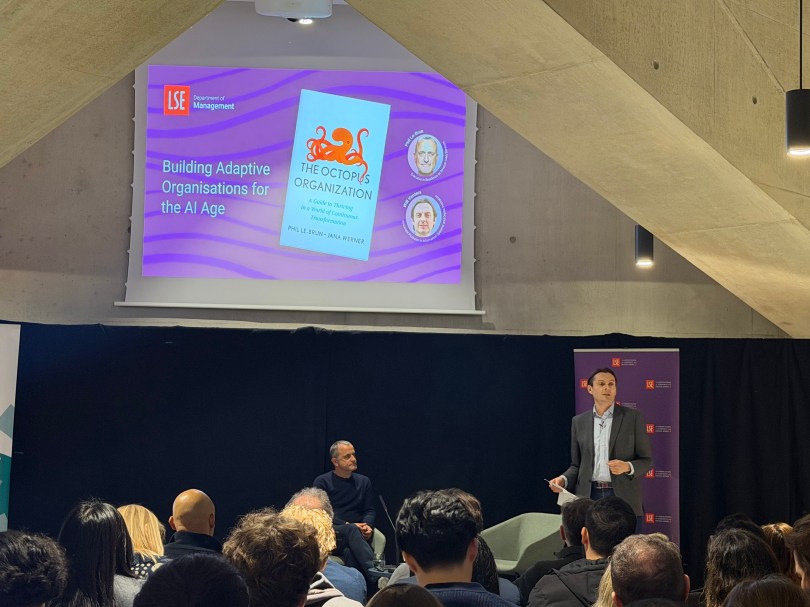
It was great to host Phil Le-Brun at the LSE last night – though sad to be his missing co-author Jana Werner. They were presenting their new book “The Octopus Organisation” https://www.theoctopusorganization.com/ which recounts a number of anti-patterns organisations must overcome to face the complexity of modern AI led business. Jana and Phil are both executives in residence at Amazon Web Services, part of a team of 15 people worldwide who advise fortune 500 executives on technology adaption, innovation and culture change.
We live in a time where AI technologies promise to transform work, yet few organizations are managing to gain the broad and deep impact of that promise. Here at the LSE last week, I heard Microsoft’s key AI Innovator talk about an “acceleration problem” in which, for most organisations, the future is arriving faster than forecast – and much faster than they can harness this “Intelligence as a Service”.
In the USA a couple of weeks ago, I heard NVIDIA’s VP for AI arguing that AI has a “systems problem” – AI is struggling to be embedded in organisational processes and systems. These views chime with emerging academic literature on the challenges of effectively introducing AI and Agentic AI into organisations.
Given that organisations themselves can be thought of as a form of artificial intelligence – social, collective, coordinated and intelligent structures responding to the world – it is time to ask if their culture, structure, leadership, R&D, and operations are ready for this artificial intelligence?
Are we at risk of just using AI to scale and increase inefficient bureaucracy we already have? I am thinking here about people who use GenAI to minute wholly unnecessary meetings, or use it to send ever more unnecessary emails? Are we at risk of creating, what our late LSE colleague Anthropologist David Graeber, might have termed “Bullshit AI Jobs”?
We discussed these and similar issues when Phil and Jana kindly consulted me in writing their book. They take a wholly different path and focus on preparing organisations and people for radical change like AI. Routed in deep thinking about people, technology and organisations, they focus on helping companies find ways to better adapt and learn. They don’t start with technology, they implore leaders to start with the organisation, and challenge what they describe as Antipatterns –the formulaic responses to complexity that, despite good intentions and surface-level appeal, consistently make things worse in all the companies they’ve studied.
Through interviews with executives in successful companies they have, as practitioners, sought to share how to overcome these antipatterns and build learning and adaptive organizations ready to address the challenges of AI today. Finally, it is a very practical book full of lessons and insight – and it’s already on my reading list for my students!
 Binary Blurring