We’re Hiring again! LSE Fellow in Information Systems and Innovation

We’re hiring at the LSE for a 2 year Fellow position starting this September! Come work with Youngjin Yoo, Edgar Whitley, and many others in our leading group researching information systems and digital innovation.

LSE Fellow in Management (ISI)

LSE is committed to building a diverse, equitable and truly inclusive university

Department of Management

LSE Fellow in Management (Information Systems and Innovation)

Salary from £42,679 to £51,000 pa inclusive with potential to progress to £54,730 pa inclusive of London allowance

This is a fixed term appointment for two years and this post will commence on 1 September 2025

The Department of Management at LSE seeks to appoint outstanding candidates in the area of Management (Information Systems and Innovation).  The department’s faculty and research strength is centred in Information Systems and Innovation, Employment Relations and Human Resource Management, Managerial Economics and Strategy, Marketing and Organisational Behaviour. The department’s faculty members are engaged in research and scholarly activity across LSE, through research centres such as the Centre for Economic Performance, the Behavioural Lab for Teaching and Research, and interdisciplinary institutes.  The department’s own portfolio of degrees includes the BSc Management, one-year and two-year MSc in Management, and six specialist one-year MSc programmes.   

The post holder will contribute to the Department’s teaching (postgraduate and/or undergraduate) and research activities in the discipline of Management (Information Systems and Innovation).   

The successful applicants must have completed or be very close to completing by the post start date, a PhD in Management including Information Systems and Innovation.  Applicants will have a very good knowledge of Management (Information Systems and Innovation) in their own specialism and breadth beyond that specialism.  As well as a developing research record in well recognised peer reviewed outlets, you will be able to work in close partnerships with fellow teachers, including on a one-on-one basis and in small groups, and provide effective support as necessary, as well as having excellent communication and presentation skills.

We offer an occupational pension scheme, generous annual leave and excellent training and development opportunities.

For further information about the post, please see the how to apply documentjob description and the person specification.

To apply for this post, please go to www.jobs.lse.ac.ukIf you have any technical queries with applying on the online system, please use the “contact us” links at the bottom of the LSE Jobs page. Should you have any queries about the role, please email dom.facultyaffairs@lse.ac.uk.  

The closing date for receipt of applications is Sunday 8 June 2025 (23.59 UK time). Regrettably, we are unable to accept any late applications.

LSE ISIG is hosting OAP Organizations, Artifacts & Practices [5-6 June 2025].

The CFP of the 15th OAP Workshop is out! This year’s theme: “Ordinary Democracy in the Making: Renewing Our Times and Spaces of Democratic Representation in and through Organization”.

One theme I am personally particularly keen to see explored in the conference is governance arrangements for digital infrastructure and how “democratic” they are (or are not).

Join us on Thursday June 5 and Friday 6th June at The London School of Economics and Political Science (LSE)

There is also a pre-workshop (DWP) on the Wednesday 4th.


Co-chairs and program committee: Will Venters, Marc LENGLET, Hélène Bussy-Socrate, Anuschka Schmitt, Tomislav Karacic, Julien MALAURENT, Attila Márton, Jeremy Pitt, François-Xavier de Vaujany and Géraldine Paring

LSE Hiring Assistant Professor in Digital Innovation

Even with two new people just starting as asssitant professors we are contining to recruit to our group! Please circulate!

JOB ADVERT TEXT:

Assistant Professor in Management (Information Systems and Innovation)

LSE is committed to building a diverse, equitable and truly inclusive university 

For this post, we welcome applications from women and people from minority ethnic groups 

Department of Management

Assistant Professor in Management 

(Information Systems and Innovation)

Salary is competitive with Departments at our peer institutions worldwide.

Salary is no less than £61,466 per annum, the salary scale can be found on the LSE website

In addition this post will attract a significant market salary supplement which reflects current market conditions.

The Department of Management plays a central role in the LSE, a global, single-faculty, social science university located in the heart of London. The Department is organised into faculty groups of information systems and innovation; employment relations and human resource management; operations management; managerial economics and strategy; organisational behaviour; and marketing. The Department’s faculty are engaged in research and scholarly activity within their faculty groups and across LSE in research centres such as the Data Science Institute and other interdisciplinary institutes. The Department’s degree portfolio includes the BSc Management, a two-year Master’s in Management, and a number of specialist one-year Master’s programmes, including the MSc Management of Information Systems and Digital Innovation (MISDI).

The Department of Management at LSE seeks to hire an outstanding Assistant Professor belonging to the Information Systems and Innovation (ISI) group. The post holder will contribute to the intellectual life of the School by conducting and publishing outstanding quality research, engaging in high quality teaching as instructed by the Head of Department, and participating in School and Department activities.

In recruiting for this position, the LSE intends to build on the ISI group’s distinctive socio-technical approach to research and education by adding depth specifically in emerging digital innovations. All members of ISI faculty are expected to contribute to our flagship degree, MSc MISDI. We will prioritise applications that show good understanding of our teaching programme and research tradition.

Successful applicants will have a PhD or be close to completing a PhD in a social science discipline and/or an interdisciplinary field relevant to Management (Information Systems and Innovation).  A track record of internationally excellent publications, or a trajectory for achieving this, as well as a well-developed strategy for future outstanding socio-technical research in information systems and innovation that has the potential to result in world-leading publications is essential. We also require a demonstrable ability to teach on undergraduate and postgraduate programmes.

The other criteria that will be used when shortlisting for this post can be found on the person specification attached to this vacancy on LSE’s online recruitment system.

In addition to a competitive salary the rewards that come with this job include an occupational pension scheme, research incentive scheme with personal reward options, generous research leave (sabbatical) entitlement, collegial faculty environment and excellent training and development opportunities.

For further information about the post, please see the how to apply documentjob description and person specification.

To apply for this post, please go to www.jobs.lse.ac.ukIf you have any technical queries with applying on the online system, please use the “contact us” links at the bottom of the LSE Jobs page. For queries about the role contact: dom.facultyaffairs@lse.ac.uk

The closing date for receipt of applications is Sunday 20 October 2024 (23.59 GMT). We are unable to accept any late applications.

LSE Information Systems and Innovation Group Colloquium 2024.

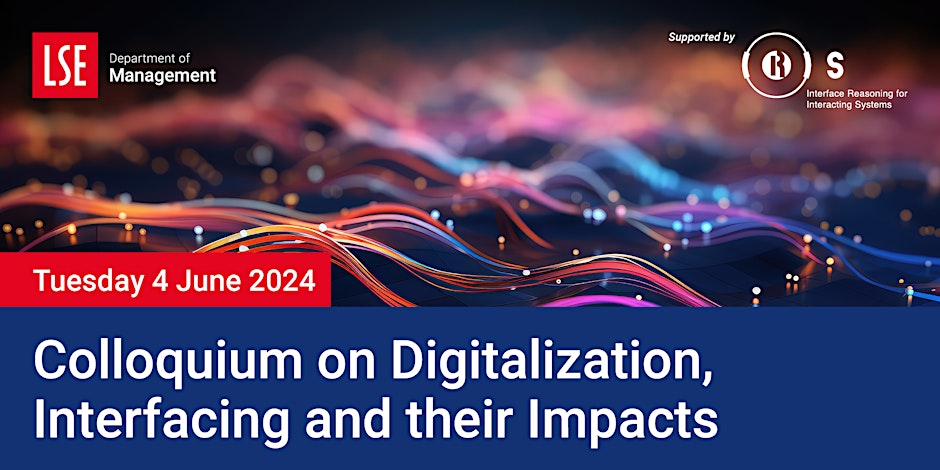
I am proud to be chairing this year’s LSE Department of Management Colloquium on Digitalization, Interfacing and their Impacts.

Tuesday, 4th June 2024 09:00 – 18:15 @ The LSE Campus Marshall Building.

The Information Systems and Innovation Group within the Department of Management, London School of Economics and Political Science is pleased to announce a Colloquium on Digitalization, Interfacing and their Impacts which will be held at the LSE campus on Tuesday 4 June 2024. The Colloquium is an opportunity for IS researchers, at any level of experience and seniority, to discuss research related to key and emerging themes surrounding Digitalization in a constructive setting. Talks from noted global IS scholars will stimulate discussion on a range of different aspects of Digitalization, including the interfacing of complex systems and the opportunities and challenges these creates for business and society. Full details of the agenda, as well as abstracts of the talks, will be provided closer to the date. The event is organised by my EPSRC funded IRIS research programme: Interface reasoning for interacting systems (IRIS).

Speakers include:

Youngjin Yoo from The Weatherhead School of Management

Ulrike Schultze from The University of Groningen.

Further speakers and full agenda to follow shortly.

To book a FREE place visit: https://www.eventbrite.com/e/colloquium-on-digitalization-interfacing-and-their-impacts-tickets-853719105827

[Assistant Professor Job] We’re recruiting again!

Having successfully just recruited two amazing new Assistant Professors to the Information Systems and Innovation Group here at the LSE we are seeking a third person to join! The advert is below but feel free to reach out to me if you have any questions! Also you’ll get to work in our brand new building above!

https://www.jobs.ac.uk/job/DGO930/assistant-professor-in-management-information-systems-and-innovation

LSE is committed to building a diverse, equitable and truly inclusive university For this post, we particularly welcome applications from women and people from minority ethnic groups.  

Salary is competitive with Departments at our peer institutions worldwide.

Salary is no less than £61,466 per annum, the salary scale can be found on the LSE website
In addition this post will attract a significant market salary supplement which reflects current market conditions.

The Department of Management plays a central role in the LSE, a global, single-faculty, social science university located in the heart of London. The Department is organised into faculty groups of information systems and innovation; employment relations and human resource management; operations management; managerial economics and strategy; organisational behaviour; and marketing. The Department’s faculty are engaged in research and scholarly activity within their faculty groups and across LSE in research centres such as the Data Science Institute and other interdisciplinary institutes. The Department’s degree portfolio includes the BSc Management, a two-year Master’s in Management, and a number of specialist one-year Master’s programmes, including the MSc Management of Information Systems and Digital Innovation (MISDI). 

The Department of Management at LSE seeks to hire an outstanding Assistant Professor belonging to the Information Systems and Innovation (ISI) group. The post holder will contribute to the intellectual life of the School by conducting and publishing outstanding quality research, engaging in high quality teaching as instructed by the Head of Department, and participating in School and Department activities. 
In recruiting for this position, the LSE intends to build on the ISI group’s distinctive socio-technical approach to research and education by adding depth specifically in emerging digital innovations. All members of ISI faculty are expected to contribute to our flagship degree, MSc MISDI. We will prioritise applications that show good understanding of our teaching programme and research tradition. 
Successful applicants will have a PhD or be close to completing a PhD by the end of 2024 in a social science discipline and/or an interdisciplinary field relevant to Management (Information Systems and Innovation). A track record of internationally excellent publications, or a trajectory for achieving this, as well as a well-developed strategy for future outstanding socio-technical research in information systems and innovation that has the potential to result in world-leading publications is essential. We also require a demonstrable ability to teach on undergraduate and postgraduate programmes. 

The other criteria that will be used when shortlisting for this post can be found on the person specification attached to this vacancy on LSE’s online recruitment system.

In addition to a competitive salary the rewards that come with this job include an occupational pension scheme, research incentive scheme with personal reward options, generous research leave (sabbatical) entitlement, collegial faculty environment and excellent training and development opportunities. 

For queries about the role contact: dom.facultyaffairs@lse.ac.uk
The closing date for receipt of applications is Sunday 26 May 2024 (23.59 GMT). We are unable to accept any late applications.

I’m recruiting: Research officer in Information Systems and Innovation (IRIS Project)

We’re recruiting for the IRIS research team at the LSE!

Research Officer in Information Systems and Innovation (lse.ac.uk)

The post holder will work on the EPSRC funded project: Interface, Reasoning for Interacting Systems (IRIS). The IRIS project is a collaboration between University College London, Imperial College of Science, Technology and Medicine, Queen Mary, University of London, and the London School of Economics and Political Science.

The successful candidate will manage all stages of the research process. This will include coordination of data gathering; research production; dissemination and communication of research findings; demonstrating the impact of the research; and contributing to applications for further research funding.  The post holder will co-author outputs for the projects and will likely co-author the academic papers.

Candidates should have expertise and research interests in Information Systems and Innovation.

A completed PhD, or close to obtaining a PhD, in Information Systems or a relevant related field by the post start date. Proven ability or potential to publish in internationally excellent publications; and experience in qualitative research method skills.

For further information about the post, please see the how to apply documentjob description and the person specification.

 If you have any technical queries with applying on the online system, please use the “contact us” links at the bottom of the LSE Jobs page. Should you have any queries about the role, please email W.Venters@lse.ac.uk  

The closing date for receipt of applications is 7 June 2021 (23.59 UK time). Regrettably, we are unable to accept any late applications.

LSE Sprint Week – in Covid times.

On this last day of term I thought I would take a moment to reflect on the online teaching of “Innovating Organisational Information Technology” at the LSE with Carsten Sorensen and, in particular, the hugely popular LSE Sprint Week; a week long sprint following Jake Knapp’s influential sprint book which I organise and run.

Old Sprint Weeks

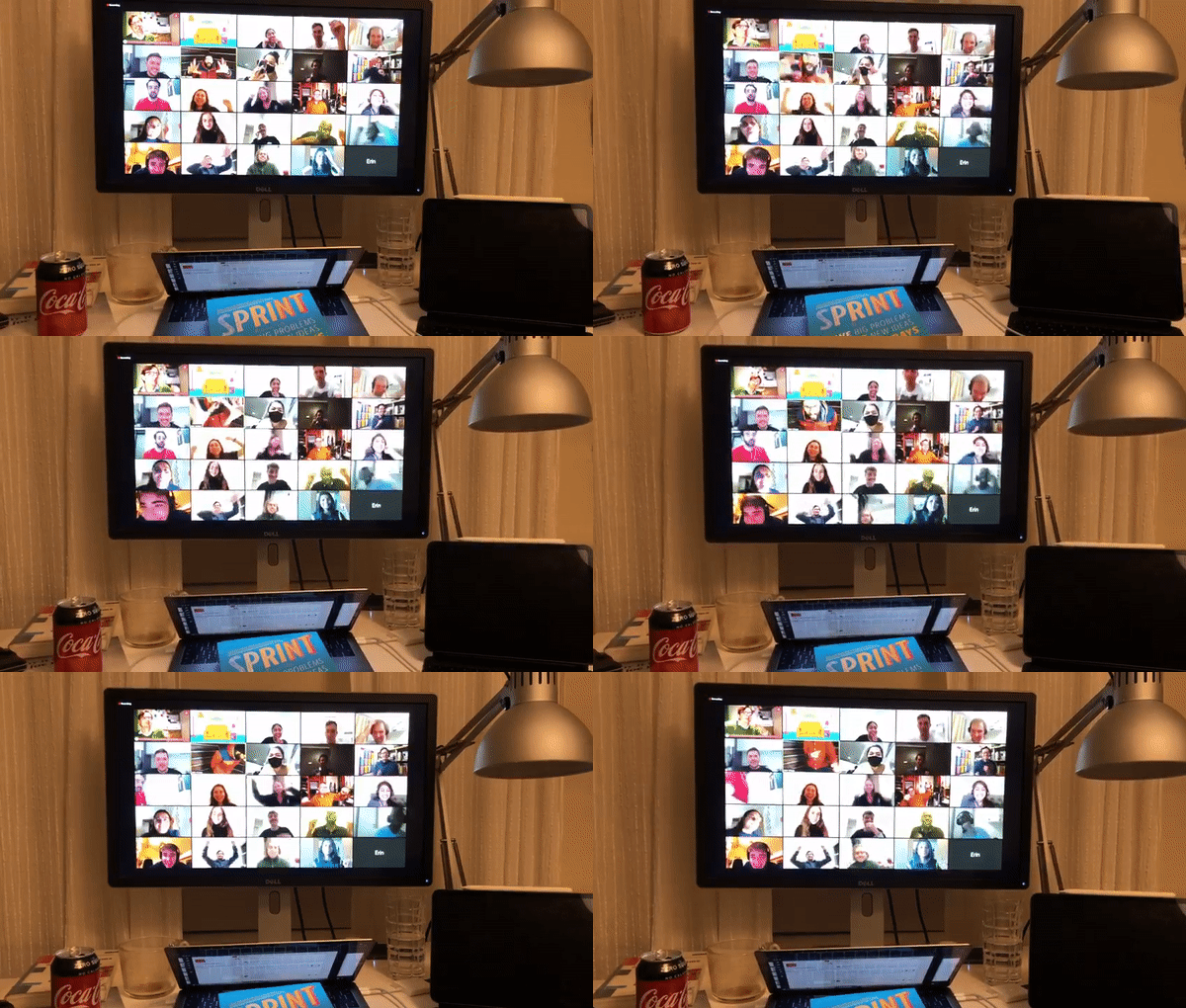
Usually this involves ~100 students working together in a huge hall around tables and whiteboards (see left). But this year, with only a couple of weeks notice, I had to move this entirely online. 110+ students, 21 parallel Sprints, various technical and administrative challenges, a real-world business problem, and world-class consultants judging on Friday afternoon. All online.

The week starts with a presentation from VISA of a significant challenge our students must address: this year it was various scenarios of fraud using the fast-payment infrastructure. Having received the challenge I released the my pre-prepared MURAL.co templates for each group to follow. The templates set out exactly what each group needed to do each day and were vital to ensuring groups could self-manage the week. Mural is a whiteboarding solution allowing you to zoom right into tiny post-it notes or images (see below). The groups would then use the templates adding their work collaboratively during the week and submitting their design via the red box on Fridays template. The template contain everything the groups needed including templates, instructions and forms.

The template was thus designed to be followed without outside facilitation by faculty and with each student in each group taking the role of group-facilitator for one of the days. In addition, dice were thrown to see who would be the “Decider” in the group – the group-CEO who could be called upon to make any tricky decision. Dice work well for this – ensuring the role is not always allocated to the loudest and most confident in the group.

One useful feature of MURAL is the ability to create rooms for shared collaboration around whiteboards. I therefore created seven rooms and clustered the groups into these allowing them to each see two other groups Mural-whiteboards. Clusters allowed groups to compare, discuss and peer-review each others work, and reduced the stress on groups as they could see how two other groups were struggling or overcoming the challenges and ask them questions. It also increased drastically social interaction among students. Each day Carsten and I met with each cluster for 30minutes – providing feedback and answering questions. This was important as it allows us to review each group quickly and maximise the time we had. Zoom was used for these meetings. We also held short “All-Hands” meetings every morning to share learning with the whole 110 students.

Outside speakers are major part of the Sprint Week and we were delighted to have Jake Knapp himself join us on two days to present and answer questions. This proved important as it reinforced that, despite not having a face to face sprint week, this was just as intense, innovative and important an experience for our students. This message was reinforced by VISA’s innovation team who have used Mural.co all this year, and by Roland Berger’s Spielfeld Digital Hub GmbH team who joined later in the week. Thanks to sponsorship from Roland Berger we could provide students with a copy of the book as well! [Jake is 4 along, 2, down, myself 2,1, Carsten 4,1].

Jake proved amazing at lightening the mood and helping the students realise that online sprints are certainly possible, and can easily be useful, innovative and fun – reinforced by organising a zoom dance session.

Scheduling

With so many moving parts during the week scheduling was vital. Outlook calendar proved the best tool available for this. Sharing my calendar with my admin support, and sending meeting invitations to all the students, either on-mass or in their clusters, allowed us to schedule the whole week. This also allowed dynamic changes during the week to be shared quickly with everyone and, crucially, handled time-zone challenges for those working overseas (though many of these students had decided to shift their body-clock for the week and so worked nights). Below is the final schedule for the week. Notice that during Wednesday and Thursday we had sessions where Roland Berger consultants mentored each group. This consultant feedback, (including from some who were our Alumni), was vital as it give industry-relevant feedback and reassured groups that the skills they were gaining were relevant to industry today! Finally we bought a cheap mobile phone and through this provided a WhatsApp, WeChat, Voice and Email helpdesk (manned by Dr Boyi Li) throughout the week.

Evaluation

During a face-to-face sprint it is easy to gauge the mood of the teams and adjust the week accordingly – indeed this is one of the key skills of a facilitator. But for twenty-one online parallel groups this was impossible. As such I devised a daily “check-in” form using Microsoft Forms which each student needed to complete nightly and which I reviewed each morning. This was helpful in showing minor points for improvement, and also extremely satisfying to see the overall rating for the the week:

Marking:

The students received two forms of feedback for Sprint Week. The first was on Friday when I invited industry experts (from Visa and Roland Berger, PA Consulting, Government and Salesforce) to form a “Dragon’s Den” to watch the video pitches each group had prepared and judge the winners based on innovativeness of the pitch. This was a wonderful experience for groups and unveiled the “winners” of sprint week – who will go forward to present their ideas to VISA’s innovation labs next year.

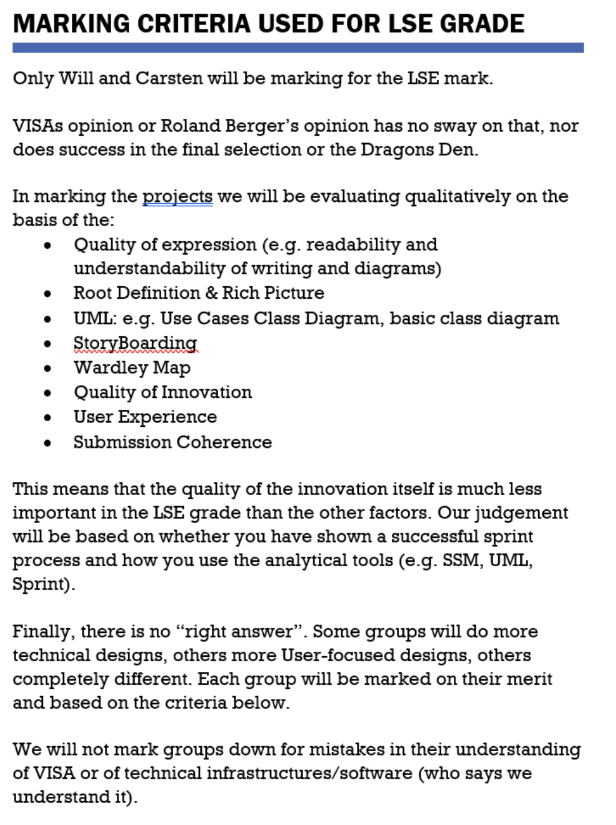
This was not however the judgement of academic success, and after Sprint Week Carsten and I carefully marked each groups project based on the following criteria (listed on each groups MURAL) for their academic grade:

Having an academic grade for Sprint Week has been important in ensuring groups feel the stress of caring about their design. Each group then received a feedback form with a few paragraphs explaining the rational for the marks and outlining any limitations in their design – thus ensuring they learnt from the entire experience.

Teamwork support

Before the week started teams were encouraged to organise a meeting and use the Team Canvas to understand their working practices and plan the week. I also held a 1hr introduction to Mural so the students would know how to use the tool effectively prior to Sprint Week.

Video Conferencing equipment:

Finally I was also lucky enough to have very good quality equipment to run Sprint Week . I used an ATEM Mini Pro video switcher and my own good camera and microphones for meetings. These tools proved invaluable during the teaching as, within zoom calls, I could add overlays with information (e.g. lower-third messages about the day) and professionally switch between devices (e.g. my video camera, an overhead camera for drawing/whiteboarding, images, my tablet as a white-board, even my phone to show a Time Timer app). During meetings for example I could put my phone as a timer in the corner of my Zoom video images to keep students to time. This technology, while expensive and complex to use, improved the professionalism of my teaching this term and, perhaps, along with the work above, helped reassured students that they were still receiving an LSE quality sprint experience online.

My “Lecture Theatre” during Sprint Week! (the tin foil on the window was to stop the camera overheating in the sun)

Wardley Mapping and building situational awareness in the age of service ecosystems.

How do executives make sense of their complex digital ecosystem of cloud services? How do they gain situational awareness? One method gaining increasing popularity in a large number of organisations is Simon Wardley’s “Wardley Mapping” technique. With Simon, and with Roser Pujadas and Mark Thompson, we have been developing and researching of how and why this technique is used. The following paper, to be presented in June at ECIS Stockholm[1], outlines the basics of the technique and our early findings.

Pujadas, R, Thompson, M., Venters, W., Wardley, S. (2019) Building situational awareness in the age of service ecosystems. 27th European Conference on Information Systems, Stockholm & Uppsala, June 2019. 

Paper Abstract:

We discuss the little-explored construct of situational awareness, which will arguably become increasingly important for strategic decision-making in the age of distributed service ecosystems, digital infrastructures, and microservices. Guided by a design science approach, we introduce a mapping artefact with the ability to enhance situational awareness within, and across, horizontal value chains, and evaluate its application in the field amongst both IS practitioners and IS researchers. We make suggestions for further research into both construct and artefact, and provide insights on their use in practice.

Keywords: Situational awareness, Distributed systems, Design Science, Strategy, Digital Ecosystems, Digital Infrastructure, modularity, servitization.

[1] ECIS, the European Conference on Information Systems, is the meeting platform for European and international researchers in the field of Information Systems. This 27th edition will take place in Sweden. We will present our paper in the “Rethinking IS Strategy and Governance in the Digital Age” research track.

For more on Simon’s Wardley Mapping see: https://en.wikipedia.org/wiki/Wardley_map or https://www.wardleymaps.com/ 

PhD in Rhythms of Information Infrastructure Cultivation: Dr Ayesha Khanna

It was fantastic to see Ayesha Khanna, my PhD student, successfully defend her PhD today. Her work focuses on the temporal nature of information infrastructures within a SmartCity initiative in Berlin identifying the importance of temporal rhythm.

The research will be of interest to practitioners involved in building smart cities, strategic niches for innovation, and for those involved in large digital infrastructure development work.  She faced an excellent viva with Dr Edgar Whitley and Professor Margunn Aanestad examining. 

PhD Thesis Abstract

This thesis investigates the importance of temporal rhythms in the study of information infrastructures (IIs), responding to the call to address an II’s “biography” by focusing on its evolution over time. It enriches understanding of how socially constructed rhythms, a temporal structure under-examined in the II literature, influence II cultivation. A strategic niche project to develop an e-mobility II in Berlin is used as the case study and reveals the influence of rhythm in disciplining (constraining) and modeling (motivating) II cultivation. It demonstrates how the intermediary mediates these influences through the interventions of harmonising, riffing and composing. Based on these interventions, the study develops the concept of facilitated II cultivation, which adds to the literature exploring the tension between planned and emergent infrastructure work. In doing so, the study presents a framework for combining short-term implementation concerns (strategic interventions by the intermediary) with long-term path dependency and evolutionary concerns (influences of past and future temporal rhythms) for IIs.

When her minor corrections are complete I will post a link to the final version of the thesis. 


Win of £6 million to research Digital Interfacing.

I am pleased to form part of a team, with computer science colleagues at UCL, Imperial and QMUL, who have been awarded a EPSRC programme grant for over £6 million to research the interfacing of digital systems. The overall research programme (titled Interface reasoning for interacting systems (IRIS)) aims to research the correct functioning of digital interfaces from technical, social, managerial and organisational perspectives – with my focus being on these latter three topics. Commercial partners involved in the programme include Amazon Web Services (UK), BT, Facebook (International), and Hewlett Packard.

Better understanding the effective management of interfacing is vital as companies and individuals harness new digital innovations and integrate them digitally within their processes and practices. Many digital innovations including the Internet of Things, SmartCities, Platforms and Artificial Intelligence, involve a myriad of systems owned and operated by a myriad of different companies which become tightly coupled together through their digital interfaces (e.g. though APIs and cloud computing). Yet little is known about how the organisations involved in such innovations define such digital interfaces, how they evolve, and in particular what organisational or management commitments are embedded within them.

The research project will formally start in January 2018, with recruitment for a post-doctoral researcher here the LSE starting shortly afterwards. The project will run until December 2023.

http://gow.epsrc.ac.uk/NGBOViewGrant.aspx?GrantRef=EP/R006865/1 

The text below provides a more academic introduction of the project.

Within the field of management, “interfaces” are of significant interest[1]; defining organisational boundaries which differentiate “insiders” and “outsiders” and providing connections across these boundaries. Interfaces are thus more broadly defined than engineered logical or digital interfaces as traditional conceived. Yet this broader understanding, in which digital interfaces are considered “boundary resources” for organisations (Eaton et al. 2015; Ghazawneh and Henfridsson 2013), is increasingly important since large-scale composite distributed organisations are emerging from the digital interfacing of organisational entities (e.g. through the growth of cloud computing[2] and the use of APIs). Within these organisational arrangements digital interfaces instantiate, represent, uphold and negotiate boundaries and separations. We therefore need to extend academic understanding of the digital interfaces between digital systems, and connect it to the social, economic and managerial boundaries and connections they create for organisations and society.

 1         Research Challenges

There is considerable research interest in boundaries within management and information systems. The internet allowed organisations to transform value-chains by digitally connecting with customers and suppliers; by harnessing cloud provided digital services (Venters and Whitley 2012); and by transforming physical products into digitally connected services (e.g. IoT – Internet of Things) (Porter and Heppelmann 2014). This transforms organisations leading to organisational arrangements whose defining characteristic is their constitution out of complex information technologies stretched across space and time, and defined by interconnections (Monteiro et al. 2014) (e.g. Netflix or Uber). Termed “cloud corporations” (Willcocks et al. 2014) such organisations evolve and change and challenge managerial and organisational assumptions of boundedness, stability, and even stable motivation of boundaries(Monteiro et al. 2014). Yet such boundary resources are poorly understood as are the wider ‘service ecosystem’ they form part of (Barros and Dumas 2006; Fishenden and Thompson 2013). There is a paucity of research on the specifics of the interface within such service ecosystems.

Consider for example Adur and Worthing[3] (a UK local council) harnessing (through Methods Consulting – a programme collaborator) Salesforce.com, Braintree Payments and MATSSoft for their services (Thompson and Venters 2015). Their value-chain leverages this extended digital supply chain such that the council is, to a significant extent, constituted from these services and must continually evolve its business, technology and management in the face of interface evolution of these components. This, it is argued, will instigate “profound changes in the ways that firms organise for innovation in the future”(Yoo et al. 2010). Reasoning about the interfaces by which such “cloud-corporations” emerge is however lacking. While sophisticated mathematical tools exist for systems modelling (Collinson et al. 2012) such tools are poorly adopted in practice. A significant focus then of this programme of work will be to seek to drive innovation in interface reasoning and systems modelling into tools for business leaders to apply in reasoning about the interfaces they are exploiting within their organisations. Further as new technologies emerge (e.g. block-chains and Machine Learning) and become available as services through interfaces so reasoning about the managerial, contractual and organisational challenges, and about the systemic nature of interfaces, is necessary. We will therefore research how computer science understanding of interfaces might be useful in understanding the social, managerial and organisational boundary.

The significance of researching interfaces as “boundary resources” has been recognised (Ghazawneh and Henfridsson 2013; Hanseth and Bygstad 2015; Yoo et al. 2010) particularly in studying software platforms whereby (Eaton et al. 2015) they are negotiated over time. These authors acknowledge we lack a coherent methodological framework for examining such boundaries – the gap we will ultimately address.

2        Scientific Approaches

This research is exploratory drawing on theoretical lenses from information systems, management and sociology as well as computer science. First we will systematically evaluate a range of theories and management ideas and evaluate their appropriateness for researching different forms of interfaces. Two specific theoretical lenses we consider within this exploratory research and application are:

Control and Coordination: Harnessing an interface cedes control for an action to a third party and devises mechanisms for control and defines boundaries. We will therefore seek to understand control and coordination in interfaces, and to devise mechanisms by which managers may better understand how they control or are controlled by interface design. This extends Venters previous work (Whitley et al. 2014) and links to ideas of control whereby interfaces are socially interpreted and significant in driving algorithmic agency and culture. This research will contribute to understanding platforms (de Reuver et al. 2017; Gawer and Cusumano 2002) whereby an interface provider is often dominant (e.g. Apple provides iOS to App developers) in providing boundary conditions for control (Eaton et al. 2015) though their boundary resources (Ghazawneh and Henfridsson 2013). This understanding will, we hope, complement and extend the resource focused modelling of control within distributed systems logic.

Temporality, emergence and evolution: Within commercial settings interfaces regularly change. This project will evaluate the relationships between evolutionary change across multiple interfaces, contexts of use, and organisational goals. Interfaces enable resources to be decoupled and recoupled generating new possibilities and increasing the liquidity of resources within value production. Exploring how interface verification alters resource liquidity may be an important avenue of study, drawing upon service dominant logic (Bardhan et al. 2010) to better understand interface consumption. Exploring how organisations can verify evolving and changing interfaces in a timely manner is an important research question for the wider research programme.

We will seek to explore the inter-organisational architectures which emerge through ecosystems: The prevalence of digital interfaces has allowed a unbundling of enterprise software from vertically integrated technology stacks (Chang and Gurbaxani 2012; Hagel and Singer 1999) towards widely distributed flat architectures spanning multiple global supplier networks (Friedman 2005; Susarla et al. 2010). Tracing and understanding this change in terms of enterprise architecture, and its impact on interfaces is relevant.

2         References

Bardhan, I., Demirkan, H., Kannan, O., and Kauffman, R. 2010. “Special Issue: Information Systems in Services,” Journal of Management Information Systems (26:4), pp. 5-12.

Barros, A. P., and Dumas, M. 2006. “The Rise of Web Service Ecosystems,” IT Professional (8:5), pp. 31-37.

Chang, Y. B., and Gurbaxani, V. 2012. “Information Technology Outsourcing, Knowledge Transfer, and Firm Productivity: An Empirical Analysis,” MIS quarterly (36:4), pp. 1043-1053.

Collinson, M., Monahan, B., and Pym, D. J. 2012. A Discipline of Mathematical Systems Modelling. College Publications.

de Reuver, M., Sorensen, C., and Basole, R. C. 2017. “The Digital Platform,” Journal of Information Technology (Forthcoming).

Eaton, B., Elaluf-Calderwood, S., Sørensen, C., and Yoo, Y. 2015. “Distributed Tuning of Boundary Resources: The Case of Apple’s  Ios Service System,” MIS Quarterly (39:1), pp. 217-243.

Fishenden, J., and Thompson, M. 2013. “Digital Government, Open Architecture, and Innovation: Why Public Sector It Will Never Be the Same Again,” Journal of Public Administration, Research, and Theory (23:4), pp. 977-104.

Friedman, T. 2005. The World Is Flat: A Brief History of the Globalized World in the 21st Century. London: Allen Lane.

Gawer, A., and Cusumano, M. 2002. Platform Leadership. Boston,MA: Harvard Business School Press.

Ghazawneh, A., and Henfridsson, O. 2013. “Balancing Platform Control and External Contribution in Third-Party Development: The Boundary Resources Model,” Information Systems Journal (23:2), pp. 173-192.

Hagel, J., and Singer, M. 1999. “Unbundling the Corporation,” Harvard business review (77), pp. 133-144.

Hanseth, O., and Bygstad, B. 2015. “Flexible Generification: Ict Standardization Strategies and Service Innovation in Health Care,” European Journal of Information Systems (24:6), pp. 654-663.

Monteiro, E., Pollock, N., and Williams, R. 2014. “Innovation in Information Infrastructures: Introduction to the Special Issue,” Journal of the Association for Information Systems (15:4), p. I.

Porter, M., and Heppelmann, J. 2014. “How Smart, Connected Products Are Transforming Competition,” Harvard Business Review).

Susarla, A., Barua, A., and Whinston, A. B. 2010. “Multitask Agency, Modular Architecture, and Task Disaggregation in Saas,” Journal of Management Information Systems (26:4), pp. 87-118.

Thompson, M., and Venters, W. 2015. “The Red Queen Hypothesis: Exploring Dynamic Service Ecosystems,” in: 4th Innovation in Information Infrastructures (III) Workshop, P. Constantinides (ed.). Warwick, UK.

Venters, W., and Whitley, E. 2012. “A Critical Review of Cloud Computing: Researching Desires and Realities,” Journal of Information Technology (27:3), pp. 179-197.

Whitley, E., Willcocks, L., and Venters, W. 2014. “Privacy and Security in the Cloud: A Review of Guidance and Responses,” Journal of Information technology and information management).

Willcocks, L., Venters, W., and Whitley, E. 2014. Moving to the  Cloud Corporation. Basingstoke: Palgrave Macmillan.

Yoo, Y., Henfridsson, O., and Lyytinen, K. 2010. “The New Organizing Logic of Digital Innovation: An Agenda for Information Systems Research,” Information Systems Research (21:4), pp. 724-735.

[1] E.g. The Academy of Management (AoM) conference theme for 2017 is “at the Interface” (premier global academic conference in management) and defines interfaces in these terms.

[2] Willcocks, L., W. Venters and E. Whitley (2014). Moving To The Cloud Corporation. Basingstoke, Palgrave Macmillan.

[3] https://www.publictechnology.net/articles/features/adur-and-worthing%E2%80%99s-journey-%E2%80%98government-platform%E2%80%99


Photo (cc) foto1897 with thanks!