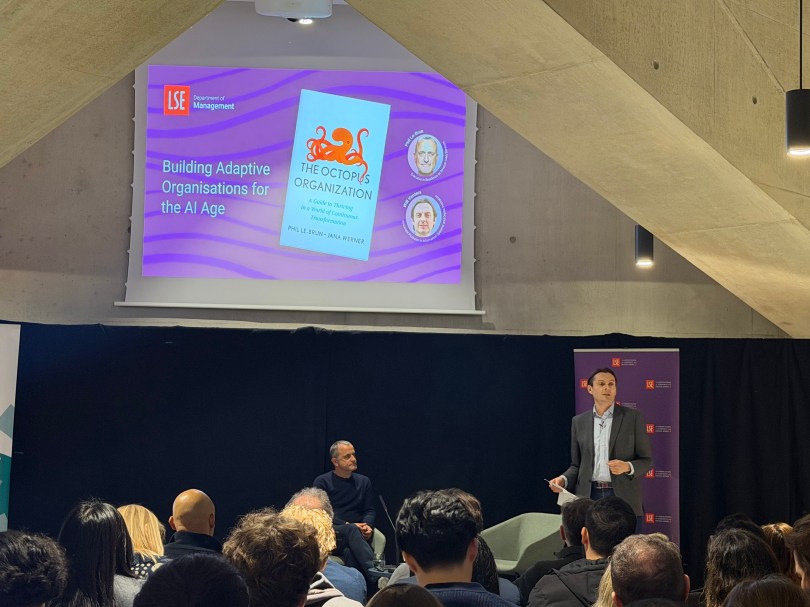
The “Octopus Organisation” – Phil Le-Brun and Jana Werner @ the LSE

It was great to host Phil Le-Brun at the LSE last night – though sad to be his missing co-author Jana Werner. They were presenting their new book “The Octopus Organisation” https://www.theoctopusorganization.com/ which recounts a number of anti-patterns organisations must overcome to face the complexity of modern AI led business. Jana and Phil are both executives in residence at Amazon Web Services, part of a team of 15 people worldwide who advise fortune 500 executives on technology adaption, innovation and culture change.

We live in a time where AI technologies promise to transform work, yet few organizations are managing to gain the broad and deep impact of that promise. Here at the LSE last week, I heard Microsoft’s key AI Innovator talk about an “acceleration problem” in which, for most organisations, the future is arriving faster than forecast – and much faster than they can harness this  “Intelligence as a Service”. 

In the USA a couple of weeks ago, I heard NVIDIA’s VP for AI arguing that AI has a “systems problem” – AI is struggling to be embedded in organisational processes and systems. These views chime with emerging academic literature on the challenges of effectively introducing AI and Agentic AI into organisations.

Given that organisations themselves can be thought of as a form of artificial intelligence – social, collective, coordinated and intelligent structures responding to the world – it is time to ask if their culture, structure, leadership, R&D, and operations are ready for this artificial intelligence?  

Are we at risk of just using AI to scale and increase inefficient bureaucracy we already have? I am thinking here about people who use GenAI to minute wholly unnecessary meetings, or use it to send ever more unnecessary emails? Are we at risk of creating, what our late LSE colleague Anthropologist David Graeber, might have termed “Bullshit AI Jobs”?

We discussed these and similar issues when Phil and Jana kindly consulted me in writing their book. They take a wholly different path and focus on preparing organisations and people for radical change like AI. Routed in deep thinking about people, technology and organisations, they focus on helping companies find ways to better adapt and learn. They don’t start with technology, they implore leaders to start with the organisation, and challenge what they describe as Antipatterns –the formulaic responses to complexity that, despite good intentions and surface-level appeal, consistently make things worse in all the companies they’ve studied.

Through interviews with executives in successful companies they have, as practitioners, sought to share how to overcome these antipatterns and build learning and adaptive organizations ready to address the challenges of AI today. Finally, it is a very practical book full of lessons and insight – and it’s already on my reading list for my students!

iSCHANNEL Journal published. (Vol 19)

https://ischannel.lse.ac.uk/23/volume/19/issue/1

This editions’ editorial (By Gonzalo San Roman)

For the 19th edition of the iSCHANNEL the journal explores the dynamic intersection between emerging digital technologies and human behaviour, through rigorous and critical examination of how these reshape ethics, governance, and human agency. Reflecting the journal’s longstanding commitment to critical inquiry and contemporary research, this year the journal brings forth insightful articles that challenge the readers to continue questioning the assumptions embedded in digital infrastructures. Emphasizing the socio-technical nature of Information Systems (IS), this edition opens new areas of research in the field and bridges key knowledge gaps by developing theoretical and practical understandings based on the findings.

Embodying this year’s mission, Louis Bardet critically explores encrypted communication technologies and addresses the paradox of encryption, illicit actors, and legal frameworks. Positioned at the intersection between cybersecurity and governance, the article offers unique insights to privacy safeguards in encrypted communication and the need for regulatory approaches to ensure fundamental protections. Anna Hrytseniuk critically evaluates the role of Big Data Analytics on Supply Chain Agility and identifies how its efficiency and success comes from a balance of technological adoption and organisational adaptability. Linking Big Data and Learning Analytics within a higher education context, Florian Lüttgenau discusses through the micro-level, meso-level, and macro-level of audiences the need for integrated socio-technical approaches. Exploring the evolving ethics and responsibilities of AI-enabled lethal weapons, Nour Louhichi questions the accountability, responsibility, ethical dilemmas, and legislative role of governments in regulating such technology. Shifting the focus from warfare to misinformation, Yutong Shi highlights the threat posed by deep fake technology and its consequences in eroding public trust. To address this, the paper proposes practical governance frameworks and the need for improvement in current detection technologies. Integrating algorithmic bias and misinformation, Rosa Sooth proposes a critical literature review in the domains of economics, democracy, and public health. Notably, in the second contribution they analyse the role of transparency in such high-stake domains and the managerial trade-off that takes place. Emphasizing human-intelligent system collaboration, Amir Dotan critically explores how AI can be holistically embedded and proposes a socio-technical, macro-level perspective through Organisational Augmentation. Dahye Jung investigates the role of actors and power dynamics in digital platforms to critically evaluate existing literature on strategic partnerships between actors. Through a participatory design, Falka von-Niessen evaluates empirical evidence on the fairness of Online Labour Platforms in the gig work industry, highlighting the impact of AI interaction on labour fairness.

Finally, as the editorial team, we extend our gratitude to all writers, reviewers, and editors for this year’s iSCHANNEL. We also thank Dr. Will Venters, Lucy Lambe, and Yao Ma for their support and guidance in creating this issue.  

About this journal

iSChannel is an annual journal on the social study of information systems which is produced, edited and double-blind reviewed by the students of the LSE Information Systems and Innovation programmes, with advice from faculty. As a core subject, our journal focuses on the study of ICTs, and the social implications of technological innovation. Still, research works from other perspectives are considered for publication, provided that they place the discussion on ICTs at the core of analysis and problematisation.