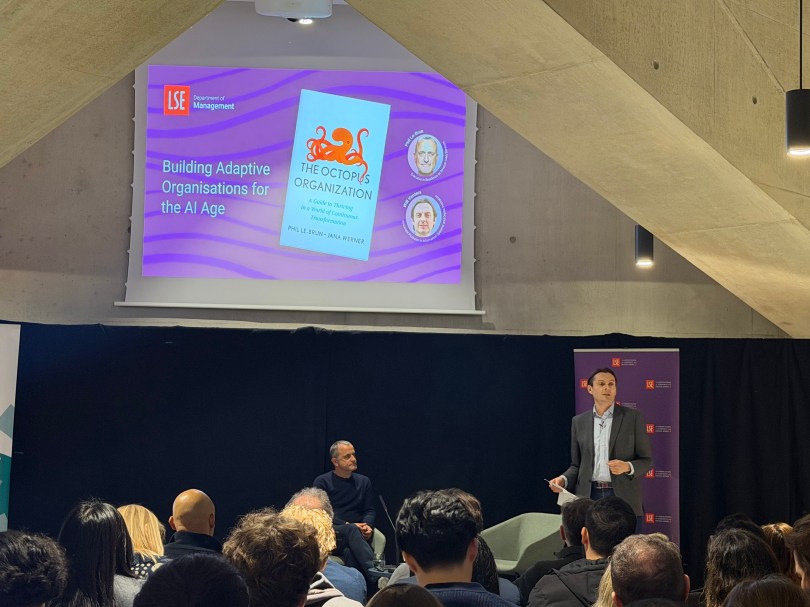
The “Octopus Organisation” – Phil Le-Brun and Jana Werner @ the LSE

It was great to host Phil Le-Brun at the LSE last night – though sad to be his missing co-author Jana Werner. They were presenting their new book “The Octopus Organisation” https://www.theoctopusorganization.com/ which recounts a number of anti-patterns organisations must overcome to face the complexity of modern AI led business. Jana and Phil are both executives in residence at Amazon Web Services, part of a team of 15 people worldwide who advise fortune 500 executives on technology adaption, innovation and culture change.

We live in a time where AI technologies promise to transform work, yet few organizations are managing to gain the broad and deep impact of that promise. Here at the LSE last week, I heard Microsoft’s key AI Innovator talk about an “acceleration problem” in which, for most organisations, the future is arriving faster than forecast – and much faster than they can harness this  “Intelligence as a Service”. 

In the USA a couple of weeks ago, I heard NVIDIA’s VP for AI arguing that AI has a “systems problem” – AI is struggling to be embedded in organisational processes and systems. These views chime with emerging academic literature on the challenges of effectively introducing AI and Agentic AI into organisations.

Given that organisations themselves can be thought of as a form of artificial intelligence – social, collective, coordinated and intelligent structures responding to the world – it is time to ask if their culture, structure, leadership, R&D, and operations are ready for this artificial intelligence?  

Are we at risk of just using AI to scale and increase inefficient bureaucracy we already have? I am thinking here about people who use GenAI to minute wholly unnecessary meetings, or use it to send ever more unnecessary emails? Are we at risk of creating, what our late LSE colleague Anthropologist David Graeber, might have termed “Bullshit AI Jobs”?

We discussed these and similar issues when Phil and Jana kindly consulted me in writing their book. They take a wholly different path and focus on preparing organisations and people for radical change like AI. Routed in deep thinking about people, technology and organisations, they focus on helping companies find ways to better adapt and learn. They don’t start with technology, they implore leaders to start with the organisation, and challenge what they describe as Antipatterns –the formulaic responses to complexity that, despite good intentions and surface-level appeal, consistently make things worse in all the companies they’ve studied.

Through interviews with executives in successful companies they have, as practitioners, sought to share how to overcome these antipatterns and build learning and adaptive organizations ready to address the challenges of AI today. Finally, it is a very practical book full of lessons and insight – and it’s already on my reading list for my students!

LSE Hiring Assistant Professor in Digital Innovation

Even with two new people just starting as asssitant professors we are contining to recruit to our group! Please circulate!

JOB ADVERT TEXT:

Assistant Professor in Management (Information Systems and Innovation)

LSE is committed to building a diverse, equitable and truly inclusive university 

For this post, we welcome applications from women and people from minority ethnic groups 

Department of Management

Assistant Professor in Management 

(Information Systems and Innovation)

Salary is competitive with Departments at our peer institutions worldwide.

Salary is no less than £61,466 per annum, the salary scale can be found on the LSE website

In addition this post will attract a significant market salary supplement which reflects current market conditions.

The Department of Management plays a central role in the LSE, a global, single-faculty, social science university located in the heart of London. The Department is organised into faculty groups of information systems and innovation; employment relations and human resource management; operations management; managerial economics and strategy; organisational behaviour; and marketing. The Department’s faculty are engaged in research and scholarly activity within their faculty groups and across LSE in research centres such as the Data Science Institute and other interdisciplinary institutes. The Department’s degree portfolio includes the BSc Management, a two-year Master’s in Management, and a number of specialist one-year Master’s programmes, including the MSc Management of Information Systems and Digital Innovation (MISDI).

The Department of Management at LSE seeks to hire an outstanding Assistant Professor belonging to the Information Systems and Innovation (ISI) group. The post holder will contribute to the intellectual life of the School by conducting and publishing outstanding quality research, engaging in high quality teaching as instructed by the Head of Department, and participating in School and Department activities.

In recruiting for this position, the LSE intends to build on the ISI group’s distinctive socio-technical approach to research and education by adding depth specifically in emerging digital innovations. All members of ISI faculty are expected to contribute to our flagship degree, MSc MISDI. We will prioritise applications that show good understanding of our teaching programme and research tradition.

Successful applicants will have a PhD or be close to completing a PhD in a social science discipline and/or an interdisciplinary field relevant to Management (Information Systems and Innovation).  A track record of internationally excellent publications, or a trajectory for achieving this, as well as a well-developed strategy for future outstanding socio-technical research in information systems and innovation that has the potential to result in world-leading publications is essential. We also require a demonstrable ability to teach on undergraduate and postgraduate programmes.

The other criteria that will be used when shortlisting for this post can be found on the person specification attached to this vacancy on LSE’s online recruitment system.

In addition to a competitive salary the rewards that come with this job include an occupational pension scheme, research incentive scheme with personal reward options, generous research leave (sabbatical) entitlement, collegial faculty environment and excellent training and development opportunities.

For further information about the post, please see the how to apply documentjob description and person specification.

To apply for this post, please go to www.jobs.lse.ac.ukIf you have any technical queries with applying on the online system, please use the “contact us” links at the bottom of the LSE Jobs page. For queries about the role contact: dom.facultyaffairs@lse.ac.uk

The closing date for receipt of applications is Sunday 20 October 2024 (23.59 GMT). We are unable to accept any late applications.