I am proud to be part of an amazing panel of faculty advisors for the AOM CTO Doctorial Consortium this summer in Chicago! Please circulate to relevant PhD Students!
The CTO Division of the Academy of Management is pleased to announce the 2024 Doctoral Consortium (DC) on Friday August 9th, 2024, in Chicago, Illinois. The DC is an opportunity for doctoral students to network, receive feedback on their research, and discuss career issues. All interested PhD students working on research at the intersection of communication, digital technology, and organizing are welcome to apply. We encourage diverse submissions from the full diversity of approaches to research on these phenomena, including behavioral, social, technical, and economic issues.
4. Aron Lindberg (Stevens Institute of Technology, USA)
5. Patrick Mikalef (Norwegian University of Science and Technology, Norway)
6. Shaila Miranda (University of Arkansas, USA)
7. Eivor Oborn (Warwick Business School, UK)
8. Jan Recker (University of Hamburg, Germany)
9. Monideepa Tarafdar (University of Massachusetts, USA)
10. Will Venters (London School of Economics, UK)
11. Sam Zaza (Middle Tennessee State University, USA)
Travel support is available for some students admitted to the DC, pending approval from the National Science Foundation (NSF). Acceptance is based on a review of the application materials.
Preference for attendance and funding will be given to students who will have defended their dissertation proposals but not their dissertations by the date of the consortium, to those who have not previously participated in the CTO DC, and to those whose institutions or fields would not otherwise be represented.
The application includes:
1) A 5-page, double-spaced, 12-point extended abstract of the proposed dissertation research.
2) A letter of recommendation from dissertation chair/advisor supporting the student’s participation in the Doctoral Consortium.
3) A 1-page informational document with: Name of applicant; PhD program university/school affiliation; Dissertation title; Expected completion date; Educational background; Professional background/prior work experience; Future career aspirations. Please indicate whether you have attended the DC before.
Important dates:
– Due date for applications and letters of recommendation is May 10th, 2024.
– DC, Friday August 9th, 2024, from 10am to 4pm. Social event offsite will follow.
– PhD students poster reception, Saturday August 10th, 2024, 6:00pm (all mentors will attend the reception).
Please email all application materials as attachments in a single email to Roberta Bernardi (roberta.bernardi@bristol.ac.uk). Please subject the email with the following: “DC CTO AOM 2024 application”.
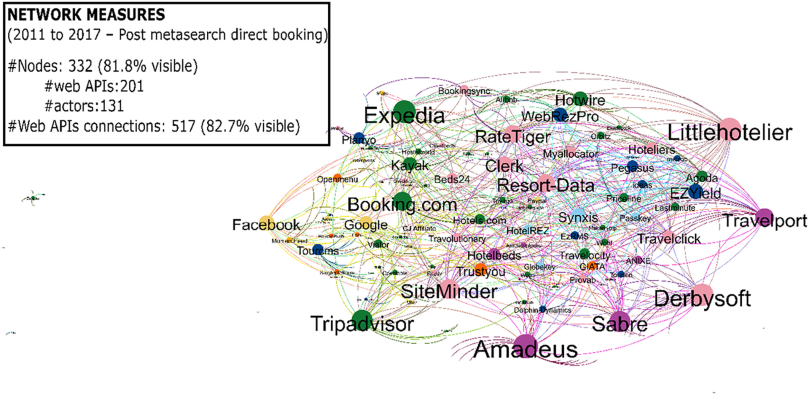
I’m happy to share that our paper “The value and structuring role of web APIs in digital innovation ecosystems: The case of the online travel ecosystem” co-authored with Roser Pujadas and Erika Valderrama has been published in Research Policy. It is available free from here (open access). The paper examines the role of interfaces (specifically APIs) within digital ecosystems.
Pujadas, R., Valderrama, E., & Venters, W. (2024). The value and structuring role of web APIs in digital innovation ecosystems: The case of the online travel ecosystem. Research Policy, 53(2), 104931. https://doi.org/https://doi.org/10.1016/j.respol.2023.104931
– We show a dynamic ecosystem where decentralized interfaces enable decentralized governance.
– We show Web APIs are easily replicated and so switching costs are relatively low. Thus, they do not easily lock-in complementors.
– We show Web APIs create synergistic interdependencies between ecosystem actors which are not only cooperative.
– We show Web APIs create networks of interorganizational systems through which services are co-produced.
– We show Web APIs are important sources of value creation and capture in digital innovation ecosystems.
We do all this through an analysis of 26 years of the online hotel booking ecosystem (1995-2021). Within the paper we present network analysis which reveals the complexity of actors involved in booking a hotel room today – see the following image for evidence of how complex this hotel booking ecosystem has become!
Some random choice quotes from the discussion section:
“Our research uncovers the distinctive structuring role and economic value of web APIs within a digital innovation ecosystem that is decentralized, and not organized around a platform technology as the focal value proposition”
“uncovers a dynamic and competitive digital ecosystem, where web APIs are not centrally controlled, and they are not only developed by incumbents, but also by new entrants offering new services or reintermediating existing ones.”
“the competitive advantage that interfaces provide to a platform or firm does not lie so much in the capacity to lock in complementors, nor even on data collection per se, but upon increasing the capacity to process and analyze data in real time, gaining valuable contextual insights within value-adding services, which can be directly monetized.”
The structuring role of web APIs in digital innovation ecosystems
“interfaces can structure directly competitive relationships within an ecosystem. For instance, by revealing, what we term, surreptitious interfacing through web scraping (e.g. by early metasearchers), we show how interfaces can be imposed upon another actor against their will. Jacobides et al. (2018 p. 2285) define an ecosystem as ‘a group of interacting firms that depend on each other’s activities’ –we might add to this: or exploit each other’s activities.“
“our research shows an ecosystem without a single orchestrator, and where a wide range of interfaces are designed and controlled by a range of actors, in a highly decentralized manner. Our research thus contributes to ecosystem orchestration and governance theory.”
The strategic value of web APIs
“Web APIs do not enable control over standards. As web APIs draw upon open shared web standards, parsing them is relatively simple and understandable, and they are agnostic to the systems they interface. This makes them relatively easy to imitate and adapt.”
“Web APIs proved ineffective tools to lock in complementors and so to establish leadership. Once an actor uses a web API, the cost of connecting to a different web API that offers the same or similar service is low, thus potentially increasing the power of suppliers and customers (Porter, 2008).”
A “consequence of low specialization costs is that the cost of establishing connections with multiple firms is relatively low…our research provides evidence of large-scale multihoming in an ecosystem built around decentralized web APIs”
“We see firms constantly adapting, changing their roles, and adding existing services by replicating web APIs, but also offering new web APIs over time. Together, this helps explain the dynamism, growth, and decentralized governance of the ecosystem”
Web APIs in value creation and capture within the digital economy
“web APIs are used by actors within a decentralized ecosystem to interface their information systems and so, to co-produce services and products…the value of web APIs is not only as a design rule…but also as a technology-in-use that enables the interaction of distributed systems.”
“…the value of web APIs is … in facilitating the production of meaningful data… attention should be focused on the exchange of information and integration of digital capabilities through web APIs, and on the real-time production of information and prediction that web APIs enable.”
“An indirect… form of value that web APIs enable is access to potential customers.”
The problem with Web APIs, AI and policy.
“We also reveal how data analytics and AI are becoming deeply embedded across such decentralized web API-based ecosystems. As AI can benefit from harvesting data from multiple sources so we expect it to become increasingly ingrained. This embedding will make it hard to research and trace AI’s impact within the digital economy– with policy implications for those regulating AI.”
Pujadas, R., Valderrama, E., & Venters, W. (2024). The value and structuring role of web APIs in digital innovation ecosystems: The case of the online travel ecosystem. Research Policy, 53(2), 104931. https://doi.org/https://doi.org/10.1016/j.respol.2023.104931
I am pleased that my jointly authored paper that asks does proximity matter in cloud adoption? has now been published in the prestigious Journal of Information Technology.
For researchers we develop an important proximity dimension to research on IT technology adoption with a focus on technologies which are assumed as remote or distant. We draw on the case of cloud computing to question existing assumptions.
For practitioners we show that those adopting cloud want a close interaction with cloud vendors, and so cloud cannot be as remote and ethereal as the metaphor implies. While it was assumed that cloud is purchased in a more impersonal and distant way and with minimal interaction between providers and purchasers, we show this not to be the case.
Analyzing the experiences of over 50+ CIOs (or equivalent) across Europe, we explore the influence of the locational (where), relational(with whom) and temporal(when) dimensions of cloud adoption. Through our case evidence we show three types of proximity in cloud adoption: Organi-technical, Mercantile, Counsel proximity (see Table below).
The influence of locational, relational and temporal dimensions on cloud adoption
Locational
Relational
Temporal
Organi-technical
Locationality of the servers and the data and their connection to the organisation.
Relationship of the organisation with existing technology.
Retrospective and future projections of the nature of, and use of, cloud technology by the organisation.
Mercantile
Locationality of the sales team and customers.
Support in identifying and selecting the desired cloud service.
Retrospective and future projections of the collaboration with the vendor’s sales function.
Counsel
Locationality of expertise to assist with the decision making, and the availability of expertise once the cloud service is in use.
Access to trusted expertise and their ability to advise on the selection and future use of the cloud-services.
Retrospective and future projections of the technology’s capacity and vendor’s capacity to assist once the cloud service is in use.
We show that during cloud adoption, organizations do not treat cloud as impersonal and location-independent by default. Consequentially, trust, mutual flexibility, value co-creation and risk-sharing between the organization and the vendor remain importantareas for future research as the cloud ecosystem evolvesand as further distributed technologies (e.g., IoT, blockchain etc.) are connected to an organization’s technological resources.
For vendors, localized sales and support functions are beneficialwithin their marketing and sales efforts. The location of data is significant. Closer vendor-IT department relationships and sales support alongside a broader ecosystem of consultancies and sales agents help adoption. Vendors’ presence at local events enhances their potentialto establish a relationship with a future customer. Local vendors can benefit from promoting their presence and locational relevance to future customers (e.g., alignment with local legislation), whereas international vendors may consider opening local branches or forming alliances with companies (e.g., consultancies) in locations with a large potential client base. Further, our findings on temporal proximity highlight the need for vendors to assist adopters in evaluating their product in relation to their existing technology and their projected future intentions (and the cloud technology’s future innovation).
We show that proximity is significant during cloud computing’s adoption. This is counter to the prevailing assumptions of cloud adoption as being more impersonal and distant, with less interaction between provider and purchaser than on-premise technologies. We do this through an interpretive study of cloud computing adopters across Europe. We develop a conceptual framework of cloud proximity which draws attention to its locational, relational and temporal proximal dimensions. Our proximal analysis leads us to identify three aspects of cloud adoption where proximity plays a key role: mercantile aspect (e.g., cloud sales support), counsel aspect (e.g., access to internal and external expertise) and organi-technical aspect (e.g., the understanding of cloud technology and services alongside their organizational adoption context). By challenging assumptions of distant and remote adoption, we contribute to the cloud computing adoption research and raise questions for IT adoption in general.
LSE is committed to building a diverse, equitable and truly inclusive university
For this post, we particularly welcome applications from women and people from minority ethnic groups.
Department of Management
Assistant Professor in Management
(Information Systems and Innovation)
Salary is competitive with Departments at our peer institutions worldwide.
Salary is no less than £61,466 per annum, the salary scale can be found on the LSE website
In addition this post will attract a significant market salary supplement which reflects current market conditions.
The Department of Management plays a central role in the LSE, a global, single-faculty, social science university located in the heart of London. The Department is organised into faculty groups of information systems and innovation; employment relations and human resource management; operations management; managerial economics and strategy; organisational behaviour; and marketing. The Department’s faculty are engaged in research and scholarly activity within their faculty groups and across LSE in research centres such as the Data Science Institute and other interdisciplinary institutes. The Department’s degree portfolio includes the BSc Management, a two-year Master’s in Management, and a number of specialist one-year Master’s programmes, including the MSc Management of Information Systems and Digital Innovation (MISDI).
The Department of Management at LSE seeks to hire an outstanding Assistant Professor belonging to the Information Systems and Innovation (ISI) group. The post holder will contribute to the intellectual life of the School by conducting and publishing outstanding quality research, engaging in high quality teaching as instructed by the Head of Department, and participating in School and Department activities.
In recruiting for this position, the LSE intends to build on the ISI group’s distinctive socio-technical approach to research and education by adding depth specifically in emerging digital innovations. All members of ISI faculty are expected to contribute to our flagship degree, MSc MISDI. We will prioritise applications that show good understanding of our teaching programme and research tradition.
Successful applicants will have a PhD or be close to completing a PhD by the post start date in a social science discipline and/or an interdisciplinary field relevant to Management (Information Systems and Innovation). A track record of internationally excellent publications, or a trajectory for achieving this, as well as a well-developed strategy for future outstanding research that has the potential to result in world-leading publications is essential. We also require a demonstrable ability to teach on undergraduate and postgraduate programmes in management.
The other criteria that will be used when shortlisting for this post can be found on the person specification attached to this vacancy on LSE’s online recruitment system.
In addition to a competitive salary the rewards that come with this job include an occupational pension scheme, research incentive scheme with personal reward options, generous research leave (sabbatical) entitlement, collegial faculty environment and excellent support, training, and development.
To apply for this post, please go to www.jobs.lse.ac.uk. If you have any technical queries with applying on the online system, please use the “contact us” links at the bottom of the LSE Jobs page. For queries about the role contact: dom.facultyaffairs@lse.ac.uk
The closing date for receipt of applications is 25 September 2023 (23.59 UK time). We are unable to accept any late applications.
This 14th OAP workshop jointly organized by Université Paris Dauphine-PSL (DRM), ESSEC and ESSEC Metalab will be an opportunity to come back to the issue of Artificial Intelligence and its relationship with the history, philosophy and politics of management and organization.
Artificial Intelligence now pervades discussions about the future of organizations and societies. AI is expected to bring deep changes in work practices and our ways of living. Utopian and dystopian narratives are abundant. However, AI is far from being a fleeting trend; rather, it constitutes a collection of techniques with a rich history dating back to the 1950s. AI serves as a broad framework deeply intertwined with ideals of rationalism and representationalism – much like the broader digital landscape it epitomizes. The aspiration in the realm of AI is that self-sufficient techniques will progressively and continuously enhance our comprehension of the world. By means of rules and the use of massive amounts of data, it is expected that learning capabilities make AI tools more and more likely to expose and elucidate the underlying realities of the processes they initially are designed to represent. Increasingly, AI transcends its role as a ‘unraveller’ of complexity in the present. It discloses our future, what will happen in the next seconds, days, month, years or centuries. It arguably encompasses the entirety of our potential futures.
As well as having a certain hold on our future(s), these powerful tools are impacting how we think. Our cognition and understanding of the world are dramatically extended, amplified, revolutionized, but also individualized, siloed, and cut off from traditional social processes of interaction and sensemaking. In this vein, the gap between our ways of acting (in an embodied way) and our ways of thinking, grows. The dualism at the heart of representationalism, although more and more visual, narrative and corporeal, become central and even foundational. Part of our cognition – and our social practice of gaining and sharing knowledge – is delegated to AI.
These artificialities of intelligence (in particular collective intelligence), will be at the heart of this 14th OAP workshop in Paris. Behind and beyond AI as a set of codes, norms, standards, and massive use of data, our intelligence is more and more artificialized. Our collective intelligence relies on a representationalist philosophy which starts from a problem (a request) submitted to Bard or Chat GPT, generative AI tools, offering then a relevant narrative likely to answer brilliantly and confidently. Co-problematization, inquiry, concerns, openness, in short, life, are not at all part of this equation. This artificial organizing process will be central in our discussions.
In particular, we welcome abstracts likely to cover the following topics:
Artificialities of intelligence as organization and organizationality;
Historical perspectives on digitality and AI;
Historical perspectives on calculative techniques, cybernetics, AI and digitality in general, in relationship with management and organizationality;
Revisiting and problematizing traditional assumptions about knowledge sharing and communities of practice;
Ethnographies, collaborative ethnographies and auto-ethnographies about AI in organizations ;
Pragmatist inquiries about collective intelligence;
Critiques of cognitivism in organization studies and management, e.g., strategic management, accounting, marketing, logistics and MIS;
Explorations of the relationships between new managerial techniques and AI;
Temporal and spatial views about AI and artificialities of intelligence;
Phenomenological and post-phenomenological perspectives about AI in organizations;
Process perspectives on the artificiality of intelligence;
Critical views of AI and the artificialities of intelligence;
AI and the metamorphosis of scientific practices;
AI the dynamic of scientific communities and scientific paradigms;
AI and its political dimension in organizations.
Of course, our event will also be opened to more traditional OAP ontological discussions around the time, space, place and materiality of organizing in a digital era, e.g., papers discussing ontologies, sociomateriality, affordances, spacing, emplacement, atmosphere, events, becoming, practices, flows, moments, existentiality, verticality, instants in the context of our digital world.
Please note that OAP 2024 will include a pre-event, the Dauphine Philosophy Workshop also hosted by University Paris Dauphine-PSL on June 6th 2024 and entitled: “Beyond judgement and legitimation: reconceptualizing the ontology of institutional dynamics in MOS”.
Those interested in our pre-OAP event and our OAP workshop must submit an extended abstract of no more than 1,000 words to workshopoap@gmail.com. The abstract must outline the applicant’s proposed contribution to the workshop. The proposal must be in .doc/.docx/.rtf format and should contain the author’s/authors’ names as well as their institutional affiliations, email address(es), and postal address(es). Deadline for submissions will be February 3rd, 2024 (midnight CET).
Authors will be notified of the committee’s decision by February 28th, 2024.
Please note that OAP 2024 will take place only onsite this year.
There are no fees associated with attending this workshop.
Organizing committee: Hélène Bussy-Socrate (PSB), François-Xavier de Vaujany (Université Paris Dauphine-PSL, DRM), Albane Grandazzi (GEM), Aurélie Leclercq-Vandelannoitte (CNRS, LEM, IESEG, Univ. Lille), Sébastien Lorenzini (Université Paris Dauphine-PSL, DRM) and Julien Mallaurent (ESSEC).
REFERENCES
Aspray, W. (1994). The history of computing within the history of information technology. History and Technology, an International Journal, 11(1), 7-19.
Berente, N., Gu, B., Recker, J., & Santhanam, R. (2021). Managing artificial intelligence. MIS quarterly, 45(3).
Chia, R. (1995). From modern to postmodern organizational analysis. Organization studies, 16(4), 579-604.
Chia, R. (2002). Essai: Time, duration and simultaneity: Rethinking process and change in organizational analysis. Organization Studies, 23(6), 863-868.
Clemson, B. (1991). Cybernetics: A new management tool (Vol. 4). CRC Press.
de Vaujany, F. X., & Mitev, N. (2017). The post-Macy paradox, information management and organising: Good intentions and a road to hell?. Culture and Organization, 23(5), 379-407.
de Vaujany, FX. (2022). Apocalypse managériale, Paris : Les Belles Lettres.
Introna, L. D., & Introna, L. D. (1997). Management: and manus. Management, Information and Power: A narrative of the involved manager, 82-117.
Nascimento, A. M., da Cunha, M. A. V. C., de Souza Meirelles, F., Scornavacca Jr, E., & De Melo, V. V. (2018). A Literature Analysis of Research on Artificial Intelligence in Management Information System (MIS). In AMCIS.
Öztürk, D. (2021). What Does Artificial Intelligence Mean for Organizations? A Systematic Review of Organization Studies Research and a Way Forward. The Impact of Artificial Intelligence on Governance, Economics and Finance, Volume I, 265-289.
Pickering, A. (2002). Cybernetics and the mangle: Ashby, Beer and Pask. Social studies of science, 32(3), 413-437.
Lorino, P. (2018). Pragmatism and organization studies. Oxford University Press.
Simpson, B., & Revsbæk, L. (Eds.). (2022). Doing Process Research in Organizations: Noticing Differently. Oxford University Press.
Thompson, N. A., & Byrne, O. (2022). Imagining futures: Theorizing the practical knowledge of future-making. Organization Studies, 43(2), 247-268.
Vesa, M., & Tienari, J. (2022). Artificial intelligence and rationalized unaccountability: Ideology of the elites?. Organization, 29(6), 1133-1145.
Wagner, G., Lukyanenko, R., & Paré, G. (2022). Artificial intelligence and the conduct of literature reviews. Journal of Information Technology, 37(2), 209-226.
Yates, J. (1993). Control through communication: The rise of system in American management (Vol. 6). JHU Press.
The following light-hearted script was for an evening talk at the London Stock Exchange for Enterprise Technology Meetup in June 2023. The speech is based on research with Dr Roser Pujadas of UCL and Dr Erika Valderamma of UMEA in Sweden.
—–
Last Tuesday the news went wild as industry and AI leaders warned that AI might pose an “existential threat” and that “Mitigating the risk of extinction from A.I. should be a global priority alongside other societal-scale risks, such as pandemics and nuclear war,”[1]. I want to address this important topic but I want to paint my own picture of what I think is wrong with some of the contemporary focus on AI, why we need to expand the frame of reference in this debate to think in terms of what I will term “Algorithmic Infrastructure”[2].
But before I do that I want to talk about spiderman. Who has seen the new spiderman animated movie? I have no idea why I went to see it since I don’t like superheroes or animated movies! We had childcare, didn’t want to eat so ended up at the movies and it beat Fast and Furious 26… Anyway I took two things from this – the first was that most of the visuals were like someone was animating on LSD, and second was that everything was connected in some spiders web of influence and connections. And that’s going what I am going to talk about – LSD and spider’s webs.
LSD … Lysergic acid diethylamide – commonly known to cause hallucinations in humans.
Alongside concerns such as putting huge numbers out of work, of spoofing identity, of affecting democracy through fake news is the concern that AI will hallucinate and so provide misinformation, and just tell plain falsehoods. But the AI like LLMs haven’t taken LSD – they are just identifying and weighing erroneous data supplied. The problem is that they learn – like a child learns – from their experience of the world. LLMs and reinforcement learning AI are a kind of modern-day Pinocchio being led astray by each experience within each element of language or photo they experience.
Pinocchio can probably pass the Turing Test that famously asks “can a machine pass off as a human”.
The problem with the turning test is that it accepts a fake human – it does not demand humanity or human level responses. In response Philosopher John Searle’s “Chinese Room Argument” from 1980 argues something different– Imagine yourself in a room alone following a computer programme for responding to Chinese characters slipped under the door. You know nothing of Chinese and yet by following the program for manipulating the symbols and numerals you send appropriate strings of Chinese characters out under the door and this leads the outside to mistakenly assume you speak Chinese. Your only experience of Chinese are the symbols you receive – is that enough?
Our Pinocchios are just machines locked inside the room of silicon they inhabit. They can only speak Chinese by following rules from the programme they got – in our case the experience of Pinocchios neural network to data it was fed in training.
For an LLM or any ML solution … their “programme” is based on the rules embedded in the data they have ingested, compared, quantified and explored within their networks and pathways. LLM Pinocchio is built from documents gleaned from the internet. This is impressive because “Language is not just words, but “a representation of the underlying complexity” of the world, observes Percy Liang, a professor at Stanford University – except where it isn’t I would argue.
Take the word “Love” or “Pain”– what does it actually mean? No matter how much you read only a human can experience these emotions. Can anything other than a human truly understand pain?
Or another way, as Wittgenstein argued, can a human know what it is to be a lion – and could a lion ever explain that to a human? Can our Pinocchio’s ever know what it is to be a human?
But worse – how can a non-lion ever know truly whether it has managed to simulate being a lion? How can the LLM police itself since it is has never experienced our reality, our lives, our culture, our way of being? It will never be able to know whether it is tripping on an LSD false-world or the real-expressed and experienced world.
If you don’t believe in the partiality of written and recorded data then think of the following example (sorry about this) visiting the restroom…. We all do it but our LLM Pinocchio will never really know that …. Nobody ever does that in books, on tv, in movies, (except in comedy ), and very seldom in written documents except medical textbooks… yet we all experience it, we all know about it as an experience but no LLM will have anything to say on that – except from a medical perspective.
This is sometimes called the frame problem. And it is easy to reveal how much context is involved in language (But less so in other forms of data which also has similar problems).
Take another example – imagine a man and a women. The man says “I am leaving you!” – The women asks “Who is she?” You instinctively know what happened, what it means, where it fits in social convention. LLMs can answer questions within the scope of human imagining and human writing – not in their own logic or understanding. My 1 year old experiences the world and lives within it (including lots of deficating) … an LLM does not.
Pinocchios can learn from high quality quantified and clear data (e.g. playing Go or Atari Video Games) or poor quality data (e.g. most data in the real world or business and enterprise). Real world data, like real-world language, is always culturally situated. Choices are made on what to keep, sensors are designed to capture what we believe and record. For example, in the seventeen centuries UK death record (around the time of plague) you could die of excessive drinking, fainting in the bath, Flox, being Found dead in street, Grief, HeadAche…
So now we need to think about what world the LLM or AI does live in… and so we turn back to Spiderman … or rather back to the spiders web of connections in the crazy multi-verse universe it talks about.
LLMs and many other generative AI learn from a spiders web of data.
At the moment, most people talk about AI and LLMs as a “product” – a thing – with we interact with. We need to avoid this firm/product centric position (Pujadas et al 2023) and instead think of webs of services within an increasingly complex API-AI Economy.
In reality, LLMs, ML etc are a service – with an input (the training data and stream of questions) and an output (answers). This is perfectly amenable to integration into the digital infrastructure of cloud-based services which underpin our modern economy. This is where my team’s research is leading.
We talk about Cloud Service Integration as the modern day enterprise development approach in which these Pinocchios are weaved and configured to provide business service through ever more Application Programming Interface connected services. We have seen an explosion of this type of cloud service integration in the last decade as cloud computing has reduced the latency of API calls such that multiple requests can occur within a normal transaction (e.g. opening a webpage can involve a multitude of API calls to a multitude of different services companies who themselves call upon multiple APIs). The spiders web of connected AI-enabled services taking inputs, undertaking complex processing, and providing outputs. Each service though has training data from the past experiences of that services (which may or may not be limited or problematic data) and driving the nature of the next.
So, to end, my worry is not that a rogue AI trips out on LSD… rather than we build an API-AI economy in which it is simply impossible to identify hallucinations, bias, unethical practices within potentially thousands of different Pinocchio’s within the spidersweb of connected interlinked services that forms such algorithmic infrastructure.
For the academics reading this blog it would be wonderful to see you at the following which the IRIS research project is sponsoring:
Research Colloquium on Digitalization and its Impacts
The Information Systems and Innovation Group within the Department of Management at the London School of Economics is pleased to announce a Colloquium on Digitalization and its Impacts which will be held on LSE campus in London on the 7th of June 2023. The Colloquium is an opportunity for IS researchers, at any level of experience and seniority, to discuss research related to key and emerging themes surrounding Digitalization in a constructive setting.
The Colloquium will include research talks from noted IS scholars representing a range of different genres as well as discussions on the nature of Digitalization, and the opportunities and challenges it creates for business and society.
Speakers include the following:
Monideepa Tarafdar, University of Massachusetts Amherst
Roberta Bernardi, University of Bristol
Stefan Seidel, University of Cologne
Philipp Hukal, Copenhagen Business School
Emmanuelle Vaast, McGill University
Full details of the agenda, as well as abstracts of the talks, will be provided closer to the date.
The colloquiumwill be held in-person and we invite IS scholars to join us. Attendance is free of charge (though attendees will have to cover their own travel and lodging costs). For administrative reasons, registration to the colloquium is required. Please click on the link below to complete your registration, no later than 31st May, 2023.
If you have any questions, do not hesitate to contact us at ISIGevent@gmail.com.
We are looking forward to seeing you in June!
Colloquium organizers:
Chrisanthi Avgerou, Saonee Sarker, Susan Scott
This event is sponsored by the EPSRC-funded project Interface Reasoning for Interacting Systems (IRIS) – EP/R006865/1.
A couple of weeks ago I chaired a Global CIO Institute conference, hosting a dinner, various talks, and round table discussions with CIOs.
What has struck me during all these interactions was the marked contrast between these CIOs at the coalface and the topics obsessed upon by LinkedIn/academic/journalistic style discussions. While CIOs are interested in topics like digital transformation, AI, robotics, data-lakes and lakehouses, the API-economy and the rise of ChatGPT (the usual LinkedIn fare) these were not what drove them. Their interest was much more on safely driving consequential innovation within their company’s line of business.
Of significant interest within this was the need to manage various forms of risk. Risk was not to be “avoided” – or as Robin Smith (CISO) at Aston Martin put it, we need to promote “positive risk taking” for innovation. All intervention generated risk. For some this manifested as needing guard-rails around IT innovation so creative and innovative staff were not constrained by the risk of a catastrophic failure. This was particularly true as low-code and citizen development expands. For CIOs, developing a culture of innovation demanded systems that allowed innovations to fail safely and elegantly.
Risk-taking behaviour within innovation was only one risk they face. Sobering conversations concerned external sources of risk and the need for business resilience in the face of pandemic, war, and cyber-security challenges. Any innovation in digital technology increases the potential surface-area that companies can be attacked through. This demands ever more sophisticated (and expensive) technical countermeasures but also cultural changes. While attention is driven towards the use of AI (like ChatGPT) for good, nefarious actors are thinking about how such tools might be used for ill. For example, attackers can use emails, telephone calls, and deep-fake video calls to sound, and even look, like a company’s CEO or top customer asking for help[1]. How can CIOs ensure their staff do not fall foul of these and various more technical scams? How can trust be established if identity is hard to prove? What happens when AI is applied to exploring possible attacks through Public APIs?
Also of significant concern was keeping-the-lights-on with their ever more demanding and heterogenous estate of products, platforms and systems. One speaker pointed out the following XKCD cartoon which captures this so well. The law of unintended consequences dominated many of their fears, particularly as organisations moved towards exploiting such new-technologies in various forms.
What was clear, and remains clear, is that we need to have a view of the enterprise technology landscape that balances risk and reward. While commentators ignore the complexity of legacy infrastructure, burgeoning bloated cloud computing estates, and the risks involved in adding more complexity to these, those tasked with managing the enterprise IT estate cannot.
These thoughts are obviously not scientific and are entirely anecdotal. The CIOs I met were often selected to attend, the conversations were steered by agenda etc. But they did remind me why CIOs are not as obsessed with ChatGPT as everyone might think.
Come join our group of Information Systems Researchers for a year: LSE Advert copied below.
LSE is committed to building a diverse, equitable and truly inclusive university
Department of Management
LSE Fellow in Management (Information Systems and Innovation)
Salary from £36,647 to £44,140 pa inclusive with potential to progress to £47,456 pa inclusive of London allowance
This is a fixed term appointment for one year
The Department of Management at LSE seeks to appoint an outstanding candidate in the area of Management – Information Systems and Innovation. The department’s faculty and research strength is centred in Employment Relations and Human Resource Management, Information Systems and innovation, Managerial Economics and Strategy, Marketing, Organisational Behaviour and Operations Management. The department’s faculty members are engaged in research and scholarly activity across LSE, through research centres such as the Centre for Economic Performance, the Behavioural Research Lab, and interdisciplinary institutes. The department’s own portfolio of degrees includes the BSc Management, one-year and two-year MSc in Management, and six specialist one-year MSc programmes.
The post holder will contribute to the Department’s teaching (postgraduate and/or undergraduate) and research activities in the discipline of Management – Information Systems and Innovation.
The successful applicants must have completed or be very close to completing by the post start date, a PhD in the area of Management including Information Systems and Innovation or a discipline relevant to the post. A developing research record in well recognised peer reviewed outlets, and a clear and viable strategy for future research in the field of Management – Information Systems and Innovation is essential; as is relevant teaching experience and excellent communication and presentation skills.
We offer an occupational pension scheme, generous annual leave and excellent training and development opportunities.
If you have any technical queries with applying on the online system, please use the “contact us” links at the bottom of the LSE Jobs page. Should you have any queries about the role, please email dom.facultyaffairs@lse.ac.uk.
The closing date for receipt of applications is 8 August 2021 (23.59 UK time). Regrettably, we are unable to accept any late applications.
An LSE Fellowship is intended to be an entry route to an academic career and is deemed by the School to be a career development position. As such, applicants who have already been employed as a LSE Fellow for three years in total are not eligible to apply. If you have any queries about this please contact the HR Division.
The post holder will work on the EPSRC funded project: Interface, Reasoning for Interacting Systems (IRIS). The IRIS project is a collaboration between University College London, Imperial College of Science, Technology and Medicine, Queen Mary, University of London, and the London School of Economics and Political Science.
The successful candidate will manage all stages of the research process. This will include coordination of data gathering; research production; dissemination and communication of research findings; demonstrating the impact of the research; and contributing to applications for further research funding. The post holder will co-author outputs for the projects and will likely co-author the academic papers.
Candidates should haveexpertise and research interests in Information Systems and Innovation.
A completed PhD, or close to obtaining a PhD, in Information Systems or a relevant related field by the post start date. Proven ability or potential to publish in internationally excellent publications; and experience in qualitative research method skills.
If you have any technical queries with applying on the online system, please use the “contact us” links at the bottom of the LSE Jobs page. Should you have any queries about the role, please email W.Venters@lse.ac.uk
The closing date for receipt of applications is 7 June 2021 (23.59 UK time). Regrettably, we are unable to accept any late applications.







 Binary Blurring
