
The following seems to sum up the use of the Cloud for users (it is from a internal Sun Beta of OpenOffice).
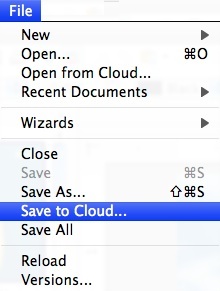
(Source – Jonathan Schwartz’s Blog.)
The following seems to sum up the use of the Cloud for users (it is from a internal Sun Beta of OpenOffice).
(Source – Jonathan Schwartz’s Blog.)
CloudCamp. A set of free events outlining cloud computing issues… the sponsor-list alone is a useful database of cloud providers.
Open cloud’ plan sparks dissent
via BBC NEWS | Technology | ‘Open cloud’ plan sparks dissent.
I clearly missed this last year – it would be interesting to explore the business rational behind the “open cloud” for IBM – and the desire for lock-in vs. open standards for the big players listed (Microsoft/Google). I suspect, given the article, that this was an attempt by IBM to grand-stand and appear a white-knight rather than a serious desire to lead an option initiative. That inter-operability is supported by SAP/AMD/Red-Hat/AT&T , SUN and CISCO is hardly surprising since their businesses are set to gain from any move to the cloud… by any provider.
Press release on BC report ‘Cloud Culture’: Also for a introduction see: http://www.edge.org/3rd_culture/leadbeater10/leadbeater10_index.html
This report discusses (in a round about way) the issue of the cultural impact of cloud computing ideas. In particular how the exposive growth in cultural heritage on the web, plus the explosion in its availability (through cloud) , will create a new “exponential growth in mass cultural expression” which is “the cultural cloud”.
Cultural relations is dominanted by small centers of production (e.g. hollywood) and Leadbeater argues a rather old argument (but still relevant) about the dilusion of local culture by this hegmony by fluid mobility (Ulrick Beck is introduced here). In summary Cloud Computing will provide a greater diversity of cultural expression. Technology cost is no longer an issue (as it was dominant in the time of Hollywood in the 1960s).”decentralised, plural and collaborative; less hierarchical, proprietary and money driven; the boundaries between amateur and professional, consumer and producer, grassroots and mainstream breached, if not erased”.
In contrast however he warns that this is not a guarentee. Power, vested interest, governments and companies may struggle to resit this change.
Campaigning is an interesting case in point. Authoritarian governments close the web and mobile network in times of difficulty (Iran, China, Thailand etc). DoS attacks on platforms, and the shere numbers of people v.s activists make a dent. He points out that 0.027% of Iran’s population of internet users provided tweets during the recent demonstrations.
He argues that cultural exchange using Clouds demands:
1) Free-speech and association (supported by the internet tools)
2) Copyright issues and intellectual property issues be addresssed.
3) Avoiding corporate control of the cultural cloud.
http://assets1.csc.com/uk/downloads/Cloud.pdf
CSC provide another Cloud Computing White Paper. Like most other companies they are relying on the “Electricity Utility” analogy in their description of clouds.
The first item on their list of “should you care about the cloud” is “Aligning costs with use – dynamically”. The second item also concerns cost – “Cutting the TCO”.
Third on their list is innovation, with speed to market fourth, and “keeping things running smoothly” as fifth (clearly a poor premise given its assumption that the Cloud is smoother). Finally their sixth reason relates to collaboration though rather vaguely – “Inspiring people to collaborate in new ways”.
This seems rather interesting – a rather downbeat and qualified reason for going to the cloud without a focus on new opportunities or risks.
Business email, calendar, documents and intranet sites for your company – Google Apps for Business.
I wonder what the difference is between this form of application hosting and internal application hosting on a server. When you install Exchange on a local server Microsoft handles the configuration of the machine, and the basic requirements. Moving to the cloud is thus about what we choose the application to manage (in the cloud then the application manages the whole hardware stack – on the server it manages just the releavant resources)…
My question is thus is SaaS cloud computing or not?
A special report on managing information: Data, data everywhere | The Economist.
Interesting set of articles on data “superabundance”
Pegasus get’s a mention in the GridPP website! http://www.gridpp.ac.uk/wider/index.html
I came across the following paper:
Weinhardt, C., A. Anandasivam, et al. (2009). “Cloud Computing – A Classification, Business Models, and Research Directions.” Business & Information Systems Engineering 1(5): 391-399.
The papers aim are to identify criteria to distinguish between Grids and Clouds. This is used to present business models ensuring Clouds sustainability. Finally the future of Cloud computing is mapped, suggesting relevant research directions. (P392).
More soon…
CSDL – IEEE Internet Computing. (September/October issue) 5
This special issue of the IEEE Internet Computing journal has a number of relevant papers on Cloud Computing.
The editorial (“having One’s Head in the Cloud) notes that we have come full circle – and that our idea of clouds is similar to the 1970s dumb-terminal acting as I/O device to a behemoth database. The central management this provided benefits but slowly we moved to the local PC.
Interestingly the editorial suggests the user as in control of the movement to the PC and subsequently the cloud. The argument is founded on the difficulties managing the updating of software (e.g. anti-virus) and of backup. The move to the cloud is thus about freeing us from this burden and is a return back to the mainframe (or at least a federated collection of mainframes).
But here I disagree with the editorial – the key difference is that this is a federated collection of “mainframes” not just one at a time. On a dumb-terminal it was difficult to integrate and “mashup” services from multiple machines locally… on the cloud this is second nature.
Leiba, B. (2009). “Having One’s Head in the Cloud.” IEEE Internet Computing 13(5): 4-6.
 Binary Blurring