Over on Forbes Antonio Piraino makes four predications for the year ahead:
Cloud Computing: Four Predictions For The Year Ahead – Forbes.
I want to discuss my opinion of each of them.
1) “The cloud wars are (still) rumbling and they’re getting louder”.
I sort of agree with the sentiment of this; that companies will be looking for value-add from cloud providers rather than simple metrics (such as network, storage or service). However I completely disagree that a battle will unfold next year – I think this is a growing market and we are seeing clear differentiation between offerings. The giants in this space are, in my opinion, desperately trying to carve out a none-competitive space in the growing cloud market, rather than going head-to-head in the battle the author describes. For that way lies only commodity offering and a drive to the bottom. I suspect that differentiation will be a more likely tactic than “war”.
2) “A titanic cloud outage will create a domino effect”.
The article argues that “As more IT resources are moved to the cloud, the chance of a major outage for a corporate enterprise… becomes exponentially more likely to occur”. Really? How on earth can the increasing outsourcing of service lead to an exponential increase in risk? The risk is dependent upon a number of factors:
1) Capability of the cloud provider to manage the service (again not dependent on the number of services managed)
2) Capability of the cloud user to contract effectively for risk (again not dependent on the number of services outsourced).
3) Multiplexing of services on a single site – this is dependent on the number of cloud users, however it is an architectural issue as to whether the risk increases. It is certainly not exponential that five companies sharing one building are at greater individual risk than if they each have their own building. The analogy of airline accidents v.s. car accidents comes to mind. When a plane fails it looks catastrophic, but more people die on the roads.
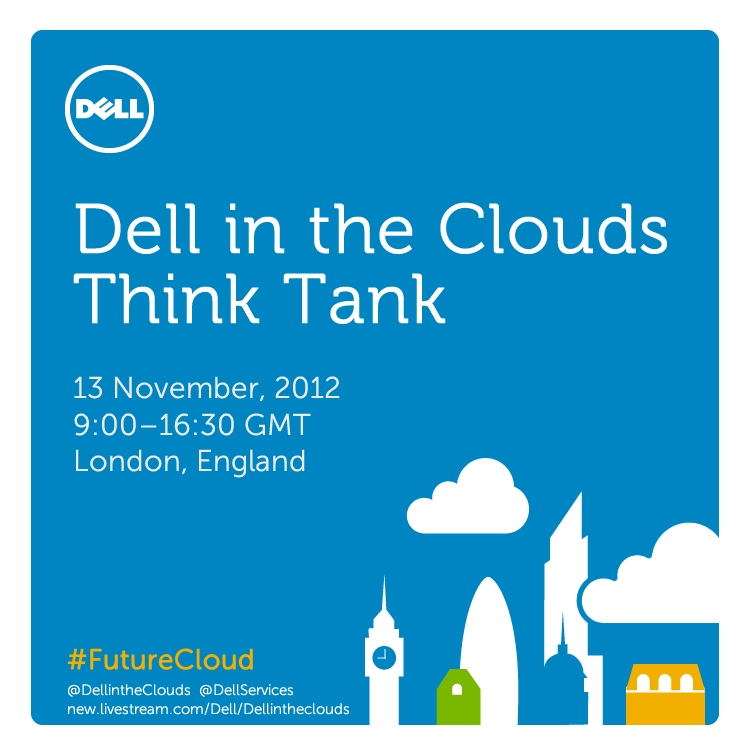
The article goes on to say that “If an unexpected cloud outage were to take place within the context of [ financial services trades] , the banks would stand to be heavily penalized for incompliance” – I absolutely agree – because if they weren’t adopting defensive approaches to moving to the cloud they would be incompetent. As a recent Dell think-tank I was part of discussed, banks are already moving to the cloud, and for mission critical activity, but they are working with cloud providers to ensure that they are getting the same level of protection and assurance as the would in-house. Like any outsourcing relationship it is incumbent on the purchaser to understand the risk, and manage it. Indeed banks should be evaluating the risk of all their ICT whether in-house or external – as the high-profile failures at Natwest recently demonstrated in-house IT can be risky too!
3) A changing role for the CIO.
Here I agree with the article. Governments will get more involved in regulation relevant to cloud, and this will create new opportunities. Whether CIOs will act as “international power-brokers, ambassadors even diplomats” as the article suggests depends on how they move to the cloud – many cloud providers intention is to create cloud offerings which do not demand an understanding of international law. I also doubt that the “human-responsibilities will shrink” – this only counts if organisations see cloud as outsourcing rather than opportunity – many CIOs are probably realising that while they are loosing headcount in certain ways (e.g. those data-centre administrators) they need skills in new applications only possible with the availability of cloud. How many CIO’s imagined managing data-analytics and social-networking specialists a few years ago?
4) Death of the desktop as we know it.
“The expectation is that an employee’s mobile device is now their workspace, and that they are accountable for contributing to work on a virtually full time basis…” I am intrigued by the idea of what is going to happen to the desktop PC. I know I use my smartphone and ipad a lot, but usually for new things rather than the same activities I use my laptop for. For example I annotate PDF’s on the train, read meeting notes during meetings, even look at documents in the bath. These are in addition to the use of my desktop PC or laptop (which I use for writing and for the host of applications I require for my work and for which I require a keyboard and solid operating system). Yes I bring-my-own-device to work, but I either demand a “desktop” like environment to run on it (i.e. integrated applications and services) in which case the management of the virtual desktop applications is as complex as the physical assets (save the plugging in and purchasing). And the idea that I will use my own device on a “virtually full time basis” is clearly none-sense… health and safety would not allow a person using a screen all day to have a smart-phone or tablet as that screen.
I don’t deny that PC’s will change, and that the technological environment of many industries is changing. But my question is whether this will increase or decrease the amount of work for the CIO? My earlier post (Cloud Computing its so 1980s) pointed out that the demand for applications within industry has not remained static or decreased – we will only increase our demand for applications. The question is then whether managing them will become easier or more difficult. For me the jury is still out but if pushed, it is for this reason that I think Windows 8 could be successful in this space.
I believe many of us are waiting for a device which capitalises on the benefits of tablets and smartphones, but which will run the complex ERP and office applications our businesses have come to rely upon. Sure we could try to make do with an iPad or Android device, but Windows 8 promises the opportunity to use the full industry proof applications we already have in a new way. I anticipate seeing lots more of these Windows 8 devices in the next few years – though with many of the applications becoming much lighter on the desktop. After all the iPad and smartphone demonstrated the importance of locally running Apps not of cloud services… they were just smaller and easier to manage applications.

 Binary Blurring