Workshop on APIs and Digital Ecosystems at ICIS 2024 – Keynote by Ben Eaton

While very last minute we would like to invite anyone interested in Interfaces, APIs, the API Economy and boundary resources role in Digital Innovations Ecosystems to come to a relaxed round-table event from 2pm-4pm on Saturday 14th December at the ICIS conference 2024 in Bangkok, Thailand. https://icis2024.aisconferences.org/

Keynote Speaker: Dr Ben Eaton – “From Interfaces to Innovation Ecosystems: Redefining Boundaries Through APIs

Ben Eaton is an Associate Professor in the Department of Digitalization at Copenhagen Business School and adjunct Associate Professor at Høyskolen Kristiania, Oslo. Ben received the ACM SIGMIS Doctoral Dissertation Award for his PhD thesis in Information Systems, which he completed at the LSE. His research interests broadly concern innovation on and within digital platforms and digital infrastructures taking into account the dynamics between architecture, governance and installed base. His work has been published in journals including MIS Quarterly, the Journal of Information Technology, Information Systems Journal, the Journal of Strategic Information Systems, Government Information Quarterly, and MIS Quarterly Executive.

Workshop Aims:

The aim will be to build a community of interest and share ideas for research and foster potential collaborations. All welcome, however seats are limited so registration would be on a first come first serve basis. Please note that the workshop is free to attend and is supported by the IRIS project (Interface Reasoning for Interactive Systems) on the UK’s Engineering and Physical Sciences Research Council -EPSRC grant (EP/R006865/1). We will feed back some of the key research from this project. 

The 2-hour workshop would begin with a keynote speech with time for Q&A, followed by two facilitated round table discussions on digital ecosystems and interfacing. 

Participation and Sharing of early stage research is absolutely welcome! If you have any ideas and would want to do something within the 2hrs, do let us know!

Key literature includes –

Gupta, A., Panagiotopoulos, P., & Bowen, F. (2023). Developing capabilities in smart city ecosystems: A multi-level approach. Organization Studies, 44(10), 1703-1724.

Pujadas, R., Valderrama, E., & Venters, W. (2024). The value and structuring role of web APIs in digital innovation ecosystems: The case of the online travel ecosystem. Research Policy, 53(2), 104931.

Wang, P. (2021). Connecting the parts with the whole: Toward an information ecology theory of digital innovation ecosystems. MIS quarterly, 45(1).

If you want to participate/ present your research/attend/ help with organisation of workshop, please feel free to contact Anushri Gupta (a.gupta140@lse.ac.uk) or Will Venters (w.venters@lse.ac.uk).

Looking forward to seeing you and engaging with the community at ICIS soon! 🙂 

Understanding AI and Large Language Models: Spiders Webs and LSD.

The following light-hearted script was for an evening talk at the London Stock Exchange for Enterprise Technology Meetup in June 2023. The speech is based on research with Dr Roser Pujadas of UCL and Dr Erika Valderamma of UMEA in Sweden.

—–

Last Tuesday the news went wild as industry and AI leaders warned that AI might pose an “existential threat” and that “Mitigating the risk of extinction from A.I. should be a global priority alongside other societal-scale risks, such as pandemics and nuclear war,”[1].  I want to address this important topic but I want to paint my own picture of what I think is wrong with some of the contemporary focus on AI, why we need to expand the frame of reference in this debate to think in terms of what I will term “Algorithmic Infrastructure”[2].

But before I do that I want to talk about spiderman.  Who has seen the new spiderman animated movie? I have no idea why I went to see it since I don’t like superheroes or animated movies! We had childcare, didn’t want to eat so ended up at the movies and it beat Fast and Furious 26… Anyway I took two things from this – the first was that most of the visuals were like someone was animating on LSD, and second was that everything was connected in some spiders web of influence and connections. And that’s going what I am going to talk about – LSD and spider’s webs.

LSD Lysergic acid diethylamide – commonly known to cause hallucinations in humans.

Alongside concerns such as putting huge numbers out of work, of spoofing identity, of affecting democracy through fake news is the concern that AI will hallucinate and so provide misinformation, and just tell plain falsehoods. But the AI like LLMs haven’t taken LSD – they are just identifying and weighing erroneous data supplied. The problem is that they learn – like a child learns – from their experience of the world. LLMs and reinforcement learning AI are a kind of modern-day Pinocchio being led astray by each experience within each element of language or photo they experience.  

Pinocchio can probably pass the Turing Test  that famously asks “can a machine pass off as a human”.

The problem with the turning test is that it accepts a fake human – it does not demand humanity or human level responses. In response Philosopher John Searle’s “Chinese Room Argument” from 1980 argues something different– Imagine yourself in a room alone following a computer programme for responding to Chinese characters slipped under the door. You know nothing of Chinese and yet by following the program for manipulating the symbols and numerals you send appropriate strings of Chinese characters out under the door and this leads the outside to mistakenly assume you speak Chinese. Your only experience of Chinese are the symbols you receive – is that enough?

Our Pinocchios are just machines locked inside the room of silicon they inhabit. They can only speak Chinese by following rules from the programme they got – in our case the experience of Pinocchios neural network to data it was fed in training.

For an LLM or any ML solution … their “programme” is based on the rules embedded in the data they have ingested, compared, quantified and explored within their networks and pathways. LLM Pinocchio is built from documents gleaned from the internet. This is impressive because “Language is not just words, but “a representation of the underlying complexity” of the world, observes Percy Liang, a professor at Stanford University – except where it isn’t I would argue.

Take the word “Love” or “Pain”– what does it actually mean? No matter how much you read only a human can experience these emotions. Can anything other than a human truly understand pain? 

Or another way, as Wittgenstein argued, can a human know what it is to be a lion – and could a lion ever explain that to a human? Can our Pinocchio’s ever know what it is to be a human?

But worse – how can a non-lion ever know truly whether it has managed to simulate being a lion? How can the LLM police itself since it is has never experienced our reality, our lives, our culture, our way of being?  It will never be able to know whether it is tripping on an LSD false-world or the real-expressed and experienced world.

If you don’t believe in the partiality of written and recorded data then think of the following example (sorry about this) visiting the restroom…. We all do it but our LLM Pinocchio will never really know that …. Nobody ever does that in books, on tv, in movies, (except in comedy ), and very seldom in written documents except medical textbooks… yet we all experience it, we all know about it as an experience but no LLM will have anything to say on that – except from a medical perspective.  

This is sometimes called the frame problem. And it is easy to reveal how much context is involved in language (But less so in other forms of data which also has similar problems).

Take another example – imagine a man and a women. The man says “I am leaving you!” – The women asks “Who is she?”  You instinctively know what happened, what it means, where it fits in social convention. LLMs can answer questions within the scope of human imagining and human writing – not in their own logic or understanding. My 1 year old experiences the world and lives within it (including lots of deficating) … an LLM does not.

Pinocchios can learn from high quality quantified and clear data (e.g. playing Go or Atari Video Games) or poor quality data (e.g. most data in the real world or business and enterprise). Real world data, like real-world language, is always culturally situated. Choices are made on what to keep, sensors are designed to capture what we believe and record.  For example, in the seventeen centuries UK death record (around the time of plague) you could die of excessive drinking, fainting in the bath, Flox, being Found dead in street, Grief, HeadAche…

So now we need to think about what world the LLM or AI does live in… and so we turn back to Spiderman … or  rather back to the spiders web of connections in the crazy multi-verse universe it talks about.

LLMs and many other generative AI learn from a spiders web of data.

At the moment, most people talk about AI and LLMs as a “product” – a thing – with we interact with. We need to avoid this firm/product centric position (Pujadas et al 2023) and instead think of webs of services within an increasingly complex API-AI Economy.

In reality, LLMs, ML etc are a service – with an input (the training data and stream of questions) and an output (answers). This is perfectly amenable to integration into the digital infrastructure of cloud-based services which underpin our modern economy. This is where my team’s research is leading.

We talk about Cloud Service Integration as the modern day enterprise development approach in which these Pinocchios are weaved and configured to provide business service through ever more Application Programming Interface connected services. We have seen an explosion of this type of cloud service integration in the last decade as cloud computing has reduced the latency of API calls such that multiple requests can occur within a normal transaction (e.g. opening a webpage can involve a multitude of API calls to a multitude of different services companies who themselves call upon multiple APIs). The spiders web of connected AI-enabled services taking inputs, undertaking complex processing, and providing outputs. Each service though has training data from the past experiences of that services (which may or may not be limited or problematic data) and driving the nature of the next.   

So, to end, my worry is not that a rogue AI trips out on LSD… rather than we build an API-AI economy in which it is simply impossible to identify hallucinations, bias, unethical practices within potentially thousands of different Pinocchio’s within the spidersweb of connected interlinked services that forms such algorithmic infrastructure.

Thank you.

© Will Venters, 2023.


[1] Statement on AI Risk | CAIS (safe.ai)

[2] Pujadas, Valderrama and Venters (2023) Forthcoming presentation at the Academy of Management Conference, Boston, USA.

Spiderman image (cc): https://commons.wikimedia.org/wiki/File:Spiderman.JPG by bortescristian used with thanks.

Recruiting Again – Research Fellow.

I am looking to recruit someone who can work in the interdisciplinary space between information systems and formal modelling. The aim is to work with a large industrial partner to build and test models (of various kinds) of systems at scale. Ideally we would find someone directly able to do that – but realistically the candidate is likely to have a stronger flavour in one of these areas.

Research Fellow – Programming Principles, Logic and Verification Group, – Ref:1820659

University College London is seeking to appoint a Research Fellow for examining modelling of large enterprise systems and architectures. This fellowship will involve working with industry partners to analyse and model their digital ecosystems. The Information Systems and Innovation group (ISIG) at the London School of Economics is well known for its research in the social, political and economic dimensions of information and communications technology.

The Interface Reasoning for Interacting Systems (IRIS) project, led by Prof. David Pym, uses logical and algebraic methods, as well as management research theory, to understand the compositional structure of systems and their communications, seeking to develop analyses at all scales, from code through distributed systems to organizational structure, generically and uniformly. The role will be jointly managed by David Pym at UCL and Will Venters at LSE’s Department of Management — a world-leading centre for Information Systems research.

The PPLV group at UCL conducts world-leading research in logical and algebraic methods and their applications to program and systems modelling and verification.

While based at UCL, the role will involve working at the LSE for around two days per week where you will have a desk.

The post is funded for 12 months in the first instance with a possible extension up to 36 months.

Ideally you will have a technical/engineering background with experience in business modelling,  business analysis, programming, and formal methods, and an understanding of qualitative and quantitative research techniques. An understanding of information systems and management research would be highly desirable, as would experience of action research or design science.

Good communication skills are essential.

Applicants must hold, or be about to receive, a PhD in information systems, logic, theoretical computer science, or a closely related area. An interest in systems modelling verification, together with underlying logical and mathematical theory, is essential. Advanced programming skills and knowledge of, or some interest in, distributed systems and/or information and systems security are highly desirable.

Appointment at Grade 7 is dependent upon having been awarded a PhD; if this is not the case, initial appointment will be at research assistant Grade 6B (salary £30,922 – £32,607 per annum) with payment at Grade 7 being backdated to the date of final submission of the PhD thesis.

Further details and how to apply:

https://atsv7.wcn.co.uk/search_engine/jobs.cgi?owner=5041404&ownertype=fair&jcode=1820659&vt_template=965&adminview=1


Professor of Information, Logic, and Security Head of Programming Principles, Logic, and Verification University College London


Turing Fellow, The Alan Turing Institute, London


d.pym@ucl.ac.uk

www.cs.ucl.ac.uk/people/D.Pym.html

www.cs.ucl.ac.uk/staff/D.Pym/


Assistant: Julia Savage, j.savage@ucl.ac.uk, +44 (0)20 7679 0327


Wardley Mapping and building situational awareness in the age of service ecosystems.

How do executives make sense of their complex digital ecosystem of cloud services? How do they gain situational awareness? One method gaining increasing popularity in a large number of organisations is Simon Wardley’s “Wardley Mapping” technique. With Simon, and with Roser Pujadas and Mark Thompson, we have been developing and researching of how and why this technique is used. The following paper, to be presented in June at ECIS Stockholm[1], outlines the basics of the technique and our early findings.

Pujadas, R, Thompson, M., Venters, W., Wardley, S. (2019) Building situational awareness in the age of service ecosystems. 27th European Conference on Information Systems, Stockholm & Uppsala, June 2019. 

Paper Abstract:

We discuss the little-explored construct of situational awareness, which will arguably become increasingly important for strategic decision-making in the age of distributed service ecosystems, digital infrastructures, and microservices. Guided by a design science approach, we introduce a mapping artefact with the ability to enhance situational awareness within, and across, horizontal value chains, and evaluate its application in the field amongst both IS practitioners and IS researchers. We make suggestions for further research into both construct and artefact, and provide insights on their use in practice.

Keywords: Situational awareness, Distributed systems, Design Science, Strategy, Digital Ecosystems, Digital Infrastructure, modularity, servitization.

[1] ECIS, the European Conference on Information Systems, is the meeting platform for European and international researchers in the field of Information Systems. This 27th edition will take place in Sweden. We will present our paper in the “Rethinking IS Strategy and Governance in the Digital Age” research track.

For more on Simon’s Wardley Mapping see: https://en.wikipedia.org/wiki/Wardley_map or https://www.wardleymaps.com/ 

ISChannel Published- Volume 13.

I’m pleased to promote the newly published ISChannel journal. The journal is wholly produced by MSc and PhD students and accepts articles concerned with socio-technical issues of information systems. I am reproducing the editorial written by Sophie Altrock, this year’s associate editor. 

To get your free copy of the journal click here.

EDITORIAL – From the Associate Editor

Currently in its 13th year of publication, the iSCHANNEL team is proud to contribute yet another series of insightful research of aspiring academics, current students, and those hungry for sharing ideas and findings with the Information Systems community. Out of a wide selection of submissions this year we agreed on a great mixture of quantitative findings and theoretical explorations of topics surrounding challenges and opportunities of our digital age.

With contributions from my fellow Associate Editors, we are happy to present five thought-provoking papers:

Alexandra Gencheva studies friction in the context of Open Banking solutions. Using the case of an Open Banking consent journey, the author explores how users perceive friction and how these perceptions and behaviours are impacted by preferences and expectations about privacy and convenience. The analysis shows that friction is perceived as a more positive encounter by participants that value privacy while it is perceived as a more negative encounter by participants that value convenience.

Pauline A. Chin, Clotilde de Maricourt, Nicolas, A. Feil, Terry L. X. Zhen, and Krittika Ray, a group of undergraduate students, explore the impact of automation in different industries looking at current and future professionals. Using a mixed method approach, the findings reveal that all participants are concerned about the automation of jobs in the near future. Students however were showing a willingness to adapt to those arising challenges by learning how to code in comparison to no willingness on the side of professionals. Findings further indicate that e.g. job security also affects concerns with the automation of jobs.

Juan Felipe Forero offers an anthropological perspective on understanding the nature of digital innovation. Deploying the concept of migration, including departing, arriving and crossing borders, the author outlines how digital innovation is a product of moves, changes and different modes of travelling. Drawing from a range of anthropological concepts and contributions, the author argues that innovation emerges as a far messier and improvised process than previously thought. To an Information Systems audience, this paper presents a fascinating insight into contributions from digital anthropology and adjacent fields.

Kadriann Pikkat provides an interesting analysis of filter bubbles enabled by social media platforms. Through an examination of this phenomenon, where the mechanisms exposing content to a user prioritise ideas that reinforce his or her own beliefs, she raises awareness of the ways users of these platforms may be unwittingly subjected to a narrowing subset of information disguised as personalisation. Kadriann reveals the ways these platforms may simplify and manipulate the complexities of social interaction and raises questions around how this reinforcement may shape users’ identities.

Maria V. Santarelli examines from a political point of view the way users give consent within social networking sites (SNS) using Facebook as a case study. By showing the analogies between a state and Facebook, she argues that consent given on a SNS resembles John Locke’s tacit consent as derived from “take it all or take nothing” Hobson’s choice. Such “tacit online consent” goes beyond the consent given to governments, calling into question the contemporary legislative means in place.

We have assembled a rich set of contributions this year and we want to thank all our authors and reviewers. Taking part in the journey from the first call for papers to the final printed journal has shown us that research is not just about counting online submissions. iSCHANNEL has brought people together, challenged reviewers to change their perspectives but, most of it all, it has offered yet another breadth of topics on all kinds of technological developments that affect us equally, now and tomorrow.

When I came to the LSE a year ago, my background in digital media studies in the field of cultural science provided me with a healthy scepticism about technologies, and the way they affect our daily lives. In the past months, however, I have come to realise the opportunities and the potential of this digital landscape for individuals and businesses if only we aspire this comprehensive view. The papers selected in this volume offer rich insights into the privacy concerns in the open banking sector and perspectives on social media platforms, accompanied by explorations of the automation of jobs and the ever narrowing information flow we are exposed to online. Adding an anthropological perspective to our selection further shows us that these topics of digital innovation should not just be addressed in the field of Information Systems alone, but rather across different areas of research. With this variety of perspectives and the growing body of knowledge that we take part in, I now see that we can continue to evolve and revolutionise our technologies with the potential to bring about more of rewarding disruptions.

In the name of iSCHANNEL, I am happy to have joined the team that has brought about another journal with intriguing findings and captivating thoughts. We now like to invite your reflections and challenge new ideas while reading through our 13th edition.

With many thanks to my fellow Associate Editors and their contributions,

Katharina B. Rohr, Jerome Retzlaff, and Kaitlyn Clark.

Special thanks goes to our Senior Editor Marta Stelmaszak who has invested a considerable amount of time and effort to make this journal possible over the past years and Dr. Will Venters, the Faculty Editor, who has once more supported us with his academic expertise and experience.

Sincerely,

Sophie Altrock

Associate Editor


PhD in Rhythms of Information Infrastructure Cultivation: Dr Ayesha Khanna

It was fantastic to see Ayesha Khanna, my PhD student, successfully defend her PhD today. Her work focuses on the temporal nature of information infrastructures within a SmartCity initiative in Berlin identifying the importance of temporal rhythm.

The research will be of interest to practitioners involved in building smart cities, strategic niches for innovation, and for those involved in large digital infrastructure development work.  She faced an excellent viva with Dr Edgar Whitley and Professor Margunn Aanestad examining. 

PhD Thesis Abstract

This thesis investigates the importance of temporal rhythms in the study of information infrastructures (IIs), responding to the call to address an II’s “biography” by focusing on its evolution over time. It enriches understanding of how socially constructed rhythms, a temporal structure under-examined in the II literature, influence II cultivation. A strategic niche project to develop an e-mobility II in Berlin is used as the case study and reveals the influence of rhythm in disciplining (constraining) and modeling (motivating) II cultivation. It demonstrates how the intermediary mediates these influences through the interventions of harmonising, riffing and composing. Based on these interventions, the study develops the concept of facilitated II cultivation, which adds to the literature exploring the tension between planned and emergent infrastructure work. In doing so, the study presents a framework for combining short-term implementation concerns (strategic interventions by the intermediary) with long-term path dependency and evolutionary concerns (influences of past and future temporal rhythms) for IIs.

When her minor corrections are complete I will post a link to the final version of the thesis. 


Teaching digital innovation at the LSE: Sprint week reflections

The following article was written by students attending the our Digital Innovation Sprint Week at the LSE:  MISDI students race to innovate during Sprint Week


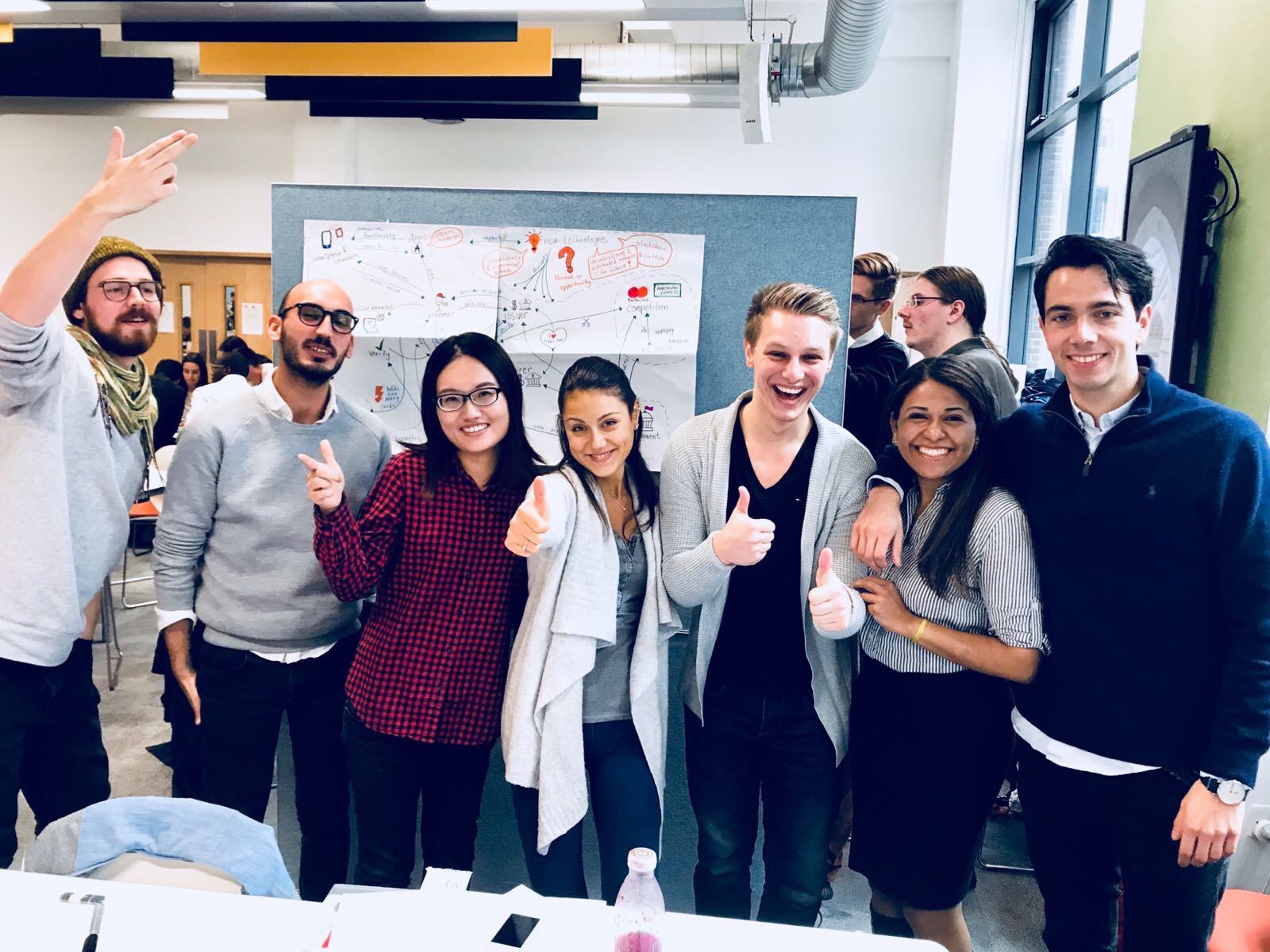
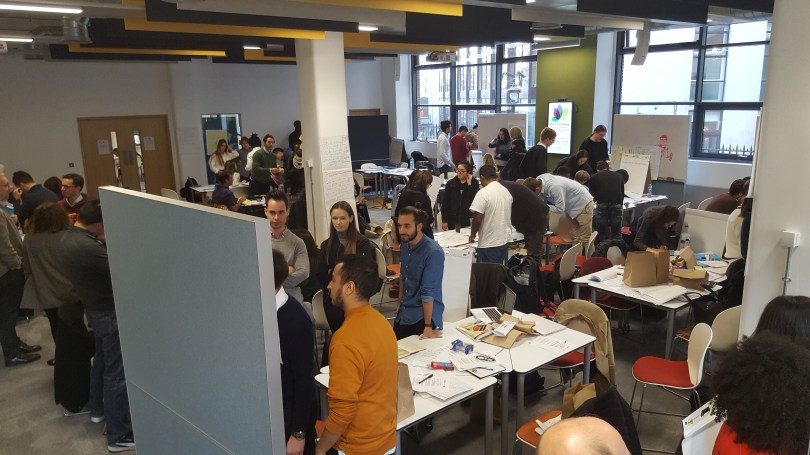
This October, 120 MSc Management, Information Systems and Digital Innovation students took part in LSE’s first ever Sprint Week- an intensive exercise in innovation and collaboration that forces teams to go from idea to prototype in just five days. It is designed to accelerate decision processes and produce clear results within a short time-span- a method used by many start-ups and innovation departments. They were supported by faculty and by consultants from Roland Berger who run similar sprint innovations for blue-chip clients, and by the client’s digital innovation expert.

In this article we hear from two students about their Sprint Week experience.

Organisations need to innovate digital products and services faster than ever before. This requires new skills for digital innovation but gaining skills is challenging. Traditional university lectures and classes are excellent at providing the vital theoretical backgrounds; for example in platforms, business strategy, digital infrastructures, systems development approaches, cloud computing and agility, yet they are poorly designed to provide a visceral understanding of how agile teams really innovate. Responding to that challenge is the aim of the Sprint Week.

Will Venters, Assistant Professor of Information Systems

martin kassethMartin Kasseth, 2017-18 MISDI student from Norway:
Tell us a little about your Sprint Week experience- which company were you working with and what approach did your team take to their problem?

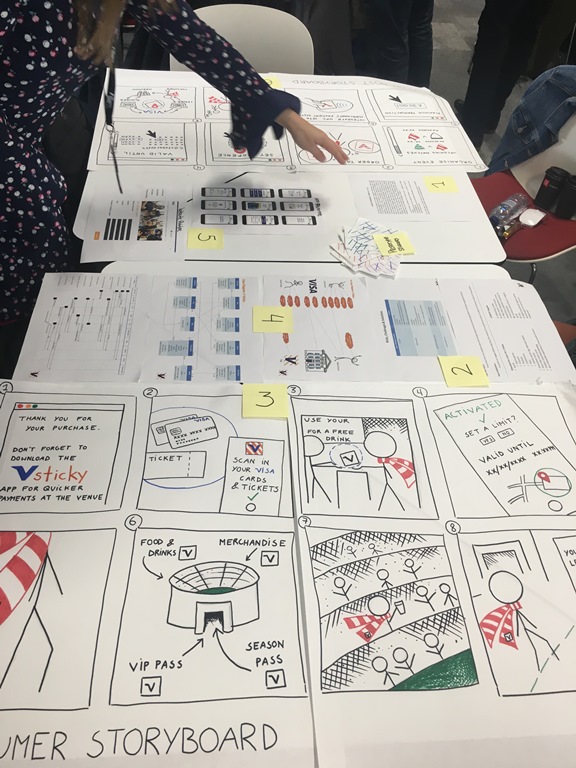
We were working on an exciting project for an internationally recognised financial company (that unfortunately I can’t name here for legal reasons), with some help from consultants from Roland Berger to come up with an innovative idea to help the corporation and their issuers (banks) to engage with younger generations. My group came up with the idea of creating a new, flexible and disposable payment mechanism that we named “VSticky”. The purpose behind the solution was to engage new generation audiences and facilitate small payments at events. Enabled by NFC (contactless) technology, these sticker devices were limited by a geo-fenced and time-limited area, and could be easily deactivated and disposed after use. The sticker is linked to your own digital wallet via a mobile app, where you can set your own spending limits. We envisaged that this solution could be used at events to allow quick and safe payments within geographically-limited areas. Possible use cases included sports games, concerts, schools/universities, street markets, conferences, amusement parks, etc.

What challenges did your team face?
I think the greatest challenge for both me and my team was communication. We were a very international team, with students from Norway, Germany, the U.S., Iran, China and Estonia. While this was one of the most exciting dimensions of the week, it also posed some communication problems. Even something as simple as saying that someone’s suggestion is “okay” might have completely different connotations in different languages and cultures. This resulted in quite a few funny episodes that we also learnt from throughout the week!

How did you do?
Of the 18 groups, the top six were selected for the last day’s “Dragon’s Den”, where representatives from the financial corporate client, external consultants and industry experts listened to the groups’ presentations and asked questions about the designs. There were many creative and really good ideas presented by all of the groups. In the end, the jury picked a winner, which actually was my team’s solution!

What was your biggest takeaway from the experience?
Probably that innovation processes are much more complex and challenging than I imagined beforehand. It is not simply enough to have a good idea – you also need to think thoroughly through the possible usage cases, target groups, the value creation, in addition to the system design itself. Nevertheless, parts of the innovation process can be compromised into a single week and still produce good results. This provided me with a method and toolkit that I am sure I will bring with me into my future career.

Everyone has the opportunity act as the group’s leader for a designated day, providing you with valuable insight into team-work management and challenges, which are crucial for your future career. Moreover, getting the opportunity to work on a real-life case challenge for a global company, with the input from industry experts, is a really inspiring factor. It is probably the best academic learning experience I have had so far during my studies!

We all got together and celebrated with a big party on the Friday – it is important to celebrate after a week with hard work!

IMG_7499 resized

_____________________________________________________________________

Timo Fuhrmann, 2017-18 MISDI student from Germany:timo

Do you have any advice for future students about Sprint Week?

Before the Sprint Week, I would definitely recommend students read the book, Sprint: How to Solve Big Problems and Test New Ideas in Just Five Days on which the project was based. It gives you a comprehensive overview and explains in detail the tasks that have to be done during the week.

The outcomes were very diverse among the 18 groups that took part in the Sprint as everyone approached the problem in a different way, leading to interesting products. My group worked on a mobile app and a smart card to unify payment and authentication. Other groups focused more on the payment aspect and also trying to approach new markets.

What did you find most challenging about the week?

I believe that the biggest challenge was to bring everyone on the same track during the first two days. There was not always a clear way forward and there were also many discussions on various aspects. We had to make sure that everyone knows our goal, agrees with it and follows it. We needed to achieve a common understanding of our main idea to be able to find a good solution and work on our prototypes. On Tuesday, we managed to overcome this challenge and found our common understanding, enabling us to work more efficiently and to come up with a great solution in the end.

What did you learn from the experience?

For me, the Sprint Week has been the highlight of the MISDI programme so far. It was intense and demanding but a lot of fun to work together with my group on a real-life problem, creating our own solution and presenting it in front of experts and receive feedback. The Sprint Week is a useful and effective concept to think about and test new product ideas. This hands-on experience gave me a good understanding of the concept and I believe that I can use this framework for my future work life.

Sprint Week1
Timo’s Team

Sprint Week2
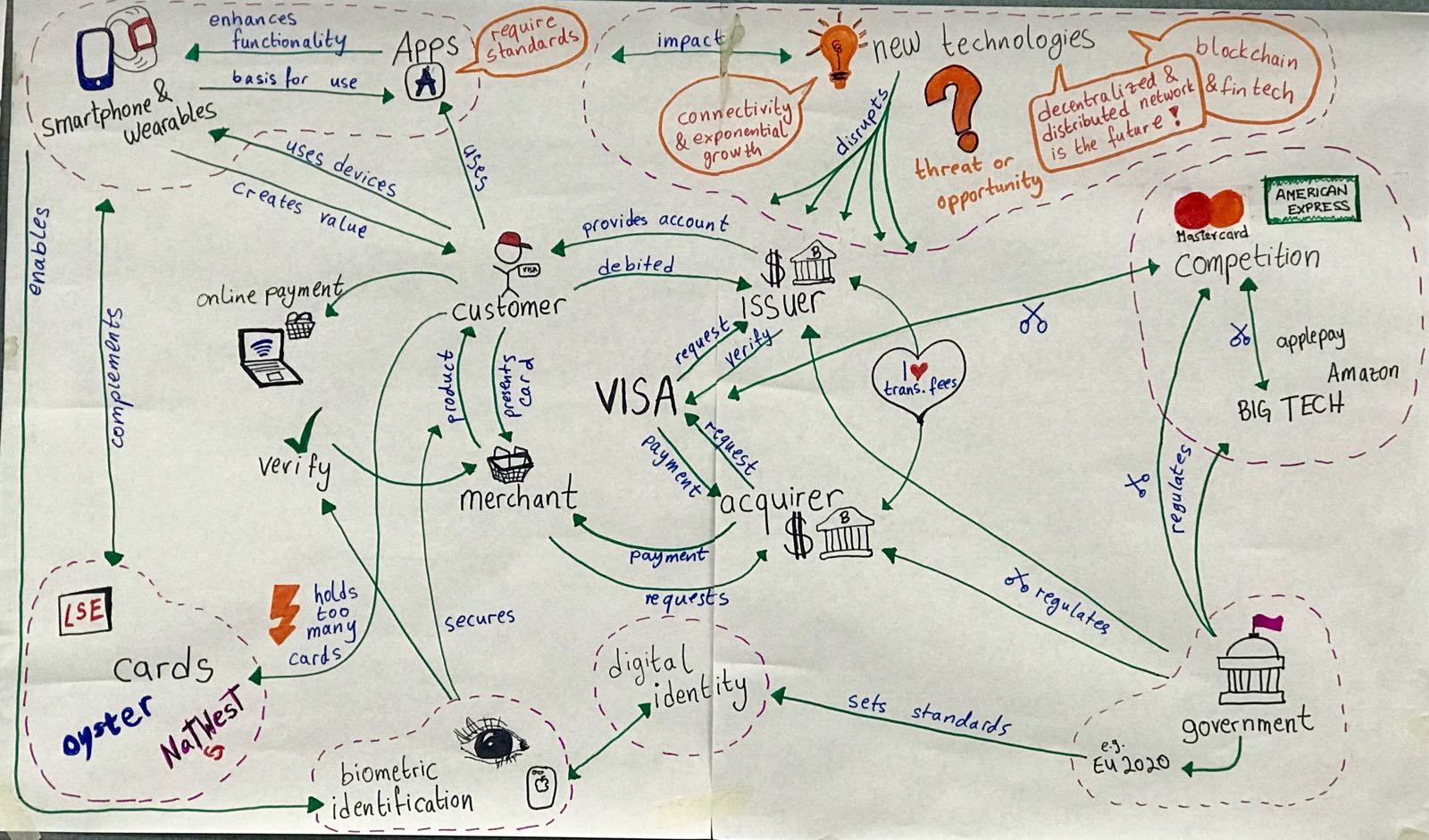
The “Rich Picture” from Day 1.

Old Sprint Weeks

Teaching digital innovation at the LSE: Sprint week with Roland Berger

Organisations need to innovate digital products and services faster than ever before. This requires new skills for digital innovation but gaining skills is challenging. Traditional university lectures and classes are excellent at providing the vital theoretical backgrounds; for example in platforms, business strategy, digital infrastructures, systems development approaches, cloud computing and agility, yet they are poorly designed to provide a visceral understanding of how agile teams really innovate. Addressing this challenge we drew inspiration from  Mark Thompson at Judge Business School who has run small sprints within their MBA and we developed a 1-week “Sprint week” bootcamp within our core MSc course.

This week all our 120+ MSc students studying “Management, Information Systems and Digital Innovation” are coming together in teams of 6 to innovate a new product or service for a real global company during a 5 day sprint [1]. They are supported by faculty and by consultants from Roland Berger who run similar sprint innovations for blue-chip clients, and by the client’s digital innovation expert.

In essence our week follows the Sprint method set out in Jake Knapp’s book “Sprint: How to solve big problems and test new ideas in just five days” with some significant changes:

  • Students will use richer (and more complex) modelling methodologies, which makes sure groups appreciate the different cultural, social and organisational perspectives within their design. This ensure they produce designs which are both systemically desirable but also “culturally feasible” wherever they will be applied.
  • Students will be pushed to not just produce solutions based on user interface or web design. They must develop a coherent digital design using basic UML modelling techniques alongside Wardley mapping techniques, to ensure a realistic strategic design.
  • Interspersed with the innovation work are a few short lectures – refreshing them on key techniques and introducing challenges their design will face.

On the Friday, the consultants will select the top groups for a Friday afternoon “Dragon’s Den” where experts from the global company, Roland Berger, and from the consulting and software industry, will put those groups through their paces – asking the difficult questions and pointing out the failings in their design. Finally, and most importantly, there is a party on the Friday evening (kindly sponsored by Roland Berger).

As the week counts for 50% of the student’s course mark, their designs will be marked by LSE academics based on LSE assessment criteria – something that is important to ensure this is not a “game” but a deliverable for our students.

Students will benefit from this unique opportunity and will experience some of the frustration, stress and elation of this kind of digital innovation work. Students will also get a chance to show in future job interviews that they know how to work in groups on digital innovation work, for a real client under real pressure.

One group might just come up with the next big thing and then, perhaps, be given a chance to work with the client to develop it further!

Will Venters 2017.

  1. Knapp, J., J. Zeratsky, and B. Kowitz, Sprint: How to solve big problems and test new ideas in just five days. 2016: Simon and Schuster.
  2. Checkland, P., Systems Thinking, Systems Practice. 1981, Chichester: Wiley. 330.
  3. Checkland, P. and J. Poulter, Learning for Action: A short definitive account of Soft Systems Methodology and its use for Practitioners, Teachers and Students. 2006, Chichester, UK: John Wiley and Sons.
  4. Checkland, P. and J. Scholes, Soft Systems Methodology in Action. 1990, Chichester: John Wiley & Sons Ltd.


The Enterprise Kindergarten for our new AI Babies? Digital Leadership Forum.

I am to be part of a panel at the Digital Leadership Forum event today discussing AI and the Enterprise.  In my opinion, the AI debate has become dominated by the AI technology and the arrival of products sold to Enterprise as “AI solutions” rather than the ecosystems and contexts in which AI algorithms will operate. It is to this that I intend to talk.

It’s ironic though that we should come see AI in this way – as a kind of “black-box” to be purchased and installed. If AI is about “learning” and “intelligence” then surely an enterprises “AI- Baby”, if it is to act sensibly, needs a carefully considered environment which is carefully controlled to help it learn? AI technology is about learning – nurturing even – to ensure the results are relevant. With human babies we spend time choosing the books they will learn from, making the nursery safe and secure, and allowing them to experience the world carefully in a controlled manner. But do enterprises think about investing similar effort in considering the training data for their new AI? And in particular considering the digital ecosystem (Kindergarten) which will provide such data? 

Examples of AI Success clearly demonstrate such a kindergarten approach. AlphaGo grew in a world of well understood problems (Go has logical rules) with data unequivocally relevant to that problem.  The team used experts in the game to hone its learning, and were on hand to drive its success.  Yet many AI solutions seem marketed as “plug-and-play” as though exposing the AI to companies’ messy, often ambiguous, and usually partial data will be fine.

So where should a CxO be spending their time when evaluating enterprise AI? I would argue they should seek to evaluate both the AI product and their organisation’s “AI kindergarten” in which the “AI product” will grow?

Thinking about this further we might recommend that:

  • CxOs should make sure that the data feeding AI represents the companies values and needs and is not biased or partial.
  • Ensure that the AI decisions are taken forward in a controlled way, and that there is human oversight. Ensure the organisation is comfortable with any AI decisions and that even when they are wrong (which AI sometimes will be) they do not harm the company.
  • Ensure that the data required to train the AI is available. As AI can require a huge amount of data to learn effectively so it may be uneconomic for a single company to seek to acquire that data (see UBERs woes in this).
  • Consider what would happen if the data-sources for AI degraded or changed (for example a sensor broke, a camera was changed, data-policy evolved or different types of data emerged). Who would be auditing the AI to ensure it continued to operate as required?
  • Finally, consider that the AI-baby will not live alone – they will be “social”. Partners or competitors might employ similar AI which, within the wider marketplace ecosystem, might affect the world in which the AI operates. (See my previous article on potential AI collusion). Famously the interacting algorithms of high-frequency traders created significant market turbulence dubbed the “flash-crash” with traders’ algorithms failed to understand the wider context of other algorithms interacting. Further, as AI often lacks transparency of its decision making, so this interacting network of AI may act unpredictably and in ways poorly understood.
Image Kassandra Bay (cc) Thanks

Digital infrastructures in organizational agility – Dr Florian Allwein

It was a great pleasure to see Florian Allwein, my PhD student, successfully defend his PhD today. The thesis has significant lessons for practitioners interested in the role of their digital technology in promoting agility within large organisations.

The abstract of Dr Allwein’s thesis:

Organizational agility has received much attention from practitioners and researchers in Information Systems. Existing research, however, has been criticised for a lack of variety. Moreover, as a consequence of digitalization, information systems are turning from traditional, monolithic systems to open systems defined by characteristics like modularity and generativity. The concept of digital infrastructures captures this shift and stresses the evolving, socio-technical nature of such systems. This thesis sees IT in large companies as digital infrastructures and organizational agility as a performance within them. In order to explain how such infrastructures can support performances of agility, a focus on the interactions between IT, information and the user and design communities within them is proposed. A case study was conducted within Telco, a large telecommunications firm in the United Kingdom. It presents three projects employees regarded as agile. Data was collected through interviews, observations of work practices and documents. A critical realist ontology is applied in order to identify generative mechanisms for agility. The mechanism of agilization – making an organization more agile by cultivating digital infrastructures and minding flows of information to attain an appropriate level of agility – is proposed to explain the interactions between digital infrastructures and performances of agility. It is supported by the related mechanisms of informatization and infrastructuralization. Furthermore, the thesis finds that large organizations do not strive for agility unreservedly, instead aiming for bounded agility in well-defined areas that does not put the business at risk. This thesis contributes to the literature by developing the concept of agility as a performance and illustrating how it aligns with digital infrastructures. The proposed mechanisms contribute to an emerging mid-range theory of organizational agility that will also be useful for practitioners. The thesis also contributes clear definitions of the terms “information” and “data” and aligns them to the ontology of critical realism.

(c) Dr Florian Allwein


Image: (cc)Erick Pleitez (Thanks)