A Cloudy Future for Microsoft?

Friends at www.horsesforsources.com (an influential Outsourcing Blog) provide a useful analysis of Microsoft’s position in the Cloud Market. The comments are perhaps more interesting than the piece…

Click here for their article – A Cloudy Future for Microsoft?.

Lock-ins, SLAs and the Cloud

One of the significant concerns in entering the cloud is the potential for lock-in with a cloud provider (though clearly you otherwise remain locked-in with your own IT department as the sole  provider).

The cost of moving from one provider to another is a significant obstacle to cloud penetration – if you could change provider easily and painlessly you might be more inclided to take the risk. Various services have emerged to try to attack this problem – CloudSwitch being one which created a considerable buzz at the Structure 2010 conference.   Their service aims to provide  a software means to transfer enterprise applications from a company’s data centre into the cloud (and between cloud providers). Whether it can live up to expectations we have yet to know, but CloudSwitch is attempting to provide a degree of portability much desired by clients – and probably much feared by Cloud Service providers whose business would reduce to utility suppliers if they are successful.

But this links into another interesting conversation I was having with a media executive last week. They mentioned that since cloud virtual machines were so cheap they often (effectively)  host services across a number of suppliers to provide their own redundancy and thus ignore the SLA. If one service goes down they can switch quickly (using load balancers etc) to another utility supplier. Clearly this only works for commodity IaaS and for relatively simple content distribution (rather than transaction processing) but it is a compelling model… why worry about choosing one cloud provider and being locked-in or risking poor SLA  – choose them all.

Structure 2010: Akamai “Doing Terabit Events” (Thanks, World Cup)

Structure 2010: Akamai “Doing Terabit Events” (Thanks, World Cup). Akamai are an interesting company which highlights the problems of latency within the cloud. But also check out the work going on in Stanford on OpenFlow http://www.openflowswitch.org/ which provides a similar in data-centre / campus level network latency response by centralising the control of the network routers/switches to best manage the flow of traffic. This work also reduces the complexity of the network and allows a more specific and intelligent  networking flow than achievable by existing routing tables.

Structure 2010 – Mark Benioff – Cloud 2

The key focus of SalesForce.com CEO Mark Benioff talk was on identifying the difference between “Cloud 2” and none-cloud marketing efforts leveraging the cloud to sell boxes. He highlighted his three tests for Cloud Compting

1)      Efficiency – that any cloud offering should offer 1/10th the cost of existing solutions and thus enable new entrants into marketplaces. For example he highlighted that only 1500 Dell servers are used to service the 77000 useres of SalesForce.

2)      Economic – that solutions should be economically efficient

3)      Democratic – That they should allow SME business to enter the market.

Nothing particularly exciting here.

Structure 2010: The Value of the Cloud — It’s Not Just About Cost

Structure 2010: The Value of the Cloud — It’s Not Just About Cost.

This article reviews a panel at the Structure Event I am attending. The argument is that focusing on Cost, as an outsourcing of cost to a cheaper provider, misses the disruptive nature of Cloud Computing. Instead the focus should be on the strategic benefits of Cloud – and hence not a CTO issue but a board-level strategy issue.

The term Business Agility was mentioned within this, and was a theme in Werner Vogals picked up on later. In particular how afraid should companies be of small competitors using Cloud to leapfrog into the marketplace as competitors to old players – the SalesForce effect.

Structure 2010 – The Cloud Computing and Internet Infrastructure Conference – GigaOM Network Events

I am going to be at the following conference this week (thanks to Accenture for the invitation).

Structure 2010 – The Cloud Computing and Internet Infrastructure Conference – GigaOM Network Events.

I will try to blog about the event during the week.

Presentation – SSIT

I hosted a panel on Cloud Computing at the SSIT 10 Global Outsourcing Workshop last week. The rather basic slides are available here: http://www.pegasus.lse.ac.uk/presentations/CloudPanelSSIT.pdf to see the video of the panel see http://tinyurl.com/2vmjaqs

Hybrid Clouds – Inside and Outside

I want to argue that our current categorisation of “Public and Private” cloud is inappropriate. Instead I want to propose a categorisation of “Inside and Outside” cloud.

Public and Private clouds imply a strict boundary between the organisation and the internet. The organisation is hidden behind a private firewall, while the outside is public.

But in reality everything sits within the cloud – including the enterprise. Using the cloud is not either-or but can be a hybrid. For example I met this week with Peter Cowley, ex MD of New Media at Endermol (makers of TV shows such a “Big Brother”). He pointed out that Endermol for some projects would  ship everything possible to the cloud (video, pictures, pages), but where personal information or critical information was used, the cloud services would hook back to an internal server. This internal server would be basic – supplying only simple HTML pages on the data, but would be integrated into the complex Cloud offering seamlessly. My Hybrid cloud is neither public nor private – it is a mix between inside and outside.

Similarly by thinking about “private clouds” internally – for internal users – we are focusing too heavily on the boundary of the enterprise. This limits options – for example allowing an outside supplier to capitalise on the “Inside Cloud” to offer new services to staff or outside customers.  For example in Telecos the internal fabric of the business (the network) might allow outside companies to run applications on it as a platform. For example an innovative ConferenceCall system – hosted within the Telcos “Inside Cloud” might be offered to the public  –  not exactly public, but neither private.

(see Creeger,M (2010) “CTO Roundtable: Cloud Computing” , Communications of the ACM, 52(8) p 50-56 for more details on the Telecoms case study).

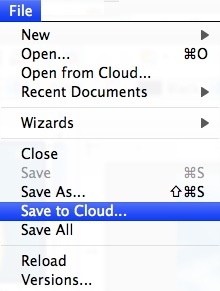
What’s wrong with this photograph?

Open Office

(Source – Jonathan Schwartz’s Blog.)

I posted an example of this picture(From a Sun MicroSystems Beta for OpenOffice) earlier in the Blog but saw it again yesterday and baulked. Fundamentally the picture misunderstands the cloud. Firstly it shows an application which is clearly based around a desktop computer installed with software – rather than software in the cloud… Secondly it suggests we would ever want to save away from the Cloud (Open/Save As)  – yes we might want to cache locally in case our connection failed but this should be handled for us – not by us!). Thirdly it suggests that we need to know what the cloud is.

Look at Google Apps for much better example of the future.

Fordism and the Cloud

In a recent Article Dustin Owens (2010) argues that elasticity defines the benefit of Cloud Computing.  He states “Elasticity could bring to the IT infrastructure what Henry Ford brought to the automotive industry with assembly lines and mass production: affordability and substantial improvements on time to market.” (p48). The article is useful and focuses primarily on security however it was the comparison with Henry Ford which got me thinking.

It is a bold statement and deserves further analysis. In particular it is unclear what Ford brought the motor industry – certainly increased penetration, increased usage, increased availability all of which are positive. Arguably though it also brought with it urban sprawl, oil-dependence, reduced wages and Tailorism. One can imagine similar problems with the cloud. Urban sprawl might be similar to flattening organisational sizes and increasing risk. For those companies whose data-centre provides competitive advantage will see an increased landscape of small competitors capitalising on the Cloud to compete – the sprawl. Our oil-dependence will similarly remain – Cloud computing hides the electricity and environmental impact of our actions in data-centres hidden from view. Purchases are unlikely to know what percentage of costs are electricity – and are unlikely to care. Finally reduced wages and Tailorism. Prior to Ford those involved in developing cars were highly skilled and worked across the line – Ford reduced this movement of skill, and Fredrick Tailor developed this into scientific management. One can see similarities in the cloud provider with increased specialism among staff  within these very large data-centres. With this comes risks – the generalist is better able to respond to radical architectural change and innovation. The generalist also has a more interesting job (a failure of Scientific Management). All this is speculation at the moment – I await my first Model T Cloud.

On another level however this comparison is interesting. because it is worth remembering that Ford was overtaken by General Motors for the simple reason that Henry Ford was against debt and demanded people pay in cash, whereas GE realised that borrowing to buy a GE car was beneficial. With the car you’re earning potential rose as you could travel for work and you were thus better able to afford the car.

In cloud computing the same might also be true. The argument behind Cloud Computing has always been that start-up ventures do not need to purchase the expensive IT equipment they can focus on  Opex not CapEx. Similarly SaaS offers reduced CapEx costs. But one might also imagine a growth of financial services industries around the cloud. For example providing short-term loans to allow small companies to ramp up websites in response to incredible demand (and perhaps insuring against this). Or allowing small media enterprises to rent cycles for rendering films as a percentage of future profits. Finally, and perhaps most importantly, if computing is a commodity we are likely to see spot-markets and commodity markets spawn. Can we imagine CDOs developing based not on sub-prime mortgages but on poorly used processor cycles within the cloud… or imagine insuring against a Denial of Service Attack such that when one occurs you can ramp up website services to respond, but not have to pay for the processor cycles! I can see many small companies taking out such insurance for their websites (if anyone profits from this – then donations received with thanks 🙂 ).

——

Owens, D (2010) “Securing Elasticity in the Cloud”, Communications of the ACM 53(6) 48-51 doi:http://doi.acm.org/10.1145/1743546.1743565