

The following article was written by students attending the our Digital Innovation Sprint Week at the LSE: MISDI students race to innovate during Sprint Week
This October, 120 MSc Management, Information Systems and Digital Innovation students took part in LSE’s first ever Sprint Week- an intensive exercise in innovation and collaboration that forces teams to go from idea to prototype in just five days. It is designed to accelerate decision processes and produce clear results within a short time-span- a method used by many start-ups and innovation departments. They were supported by faculty and by consultants from Roland Berger who run similar sprint innovations for blue-chip clients, and by the client’s digital innovation expert.
In this article we hear from two students about their Sprint Week experience.
Organisations need to innovate digital products and services faster than ever before. This requires new skills for digital innovation but gaining skills is challenging. Traditional university lectures and classes are excellent at providing the vital theoretical backgrounds; for example in platforms, business strategy, digital infrastructures, systems development approaches, cloud computing and agility, yet they are poorly designed to provide a visceral understanding of how agile teams really innovate. Responding to that challenge is the aim of the Sprint Week.
Will Venters, Assistant Professor of Information Systems
 Martin Kasseth, 2017-18 MISDI student from Norway:
Tell us a little about your Sprint Week experience- which company were you working with and what approach did your team take to their problem?
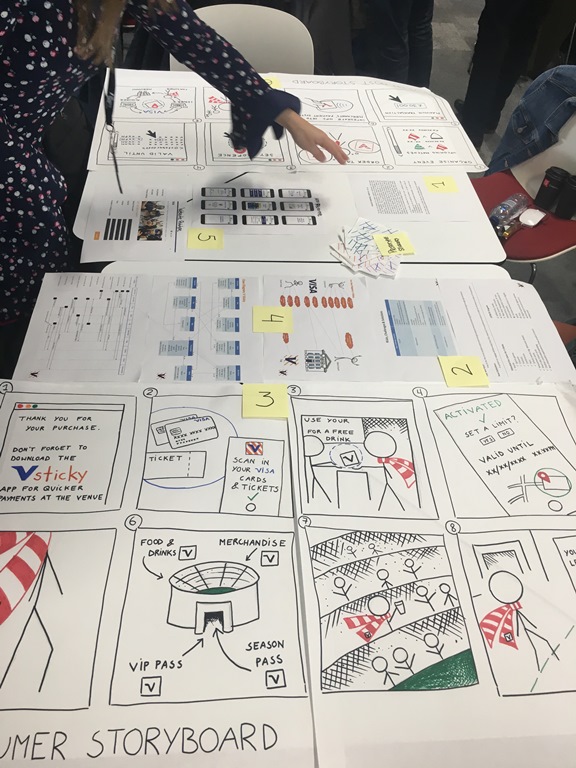
We were working on an exciting project for an internationally recognised financial company (that unfortunately I can’t name here for legal reasons), with some help from consultants from Roland Berger to come up with an innovative idea to help the corporation and their issuers (banks) to engage with younger generations. My group came up with the idea of creating a new, flexible and disposable payment mechanism that we named “VSticky”. The purpose behind the solution was to engage new generation audiences and facilitate small payments at events. Enabled by NFC (contactless) technology, these sticker devices were limited by a geo-fenced and time-limited area, and could be easily deactivated and disposed after use. The sticker is linked to your own digital wallet via a mobile app, where you can set your own spending limits. We envisaged that this solution could be used at events to allow quick and safe payments within geographically-limited areas. Possible use cases included sports games, concerts, schools/universities, street markets, conferences, amusement parks, etc.
What challenges did your team face?
I think the greatest challenge for both me and my team was communication. We were a very international team, with students from Norway, Germany, the U.S., Iran, China and Estonia. While this was one of the most exciting dimensions of the week, it also posed some communication problems. Even something as simple as saying that someone’s suggestion is “okay” might have completely different connotations in different languages and cultures. This resulted in quite a few funny episodes that we also learnt from throughout the week!
How did you do?
Of the 18 groups, the top six were selected for the last day’s “Dragon’s Den”, where representatives from the financial corporate client, external consultants and industry experts listened to the groups’ presentations and asked questions about the designs. There were many creative and really good ideas presented by all of the groups. In the end, the jury picked a winner, which actually was my team’s solution!
What was your biggest takeaway from the experience?
Probably that innovation processes are much more complex and challenging than I imagined beforehand. It is not simply enough to have a good idea – you also need to think thoroughly through the possible usage cases, target groups, the value creation, in addition to the system design itself. Nevertheless, parts of the innovation process can be compromised into a single week and still produce good results. This provided me with a method and toolkit that I am sure I will bring with me into my future career.
Everyone has the opportunity act as the group’s leader for a designated day, providing you with valuable insight into team-work management and challenges, which are crucial for your future career. Moreover, getting the opportunity to work on a real-life case challenge for a global company, with the input from industry experts, is a really inspiring factor. It is probably the best academic learning experience I have had so far during my studies!
We all got together and celebrated with a big party on the Friday – it is important to celebrate after a week with hard work!
_____________________________________________________________________
Timo Fuhrmann, 2017-18 MISDI student from Germany:
Do you have any advice for future students about Sprint Week?
Before the Sprint Week, I would definitely recommend students read the book, Sprint: How to Solve Big Problems and Test New Ideas in Just Five Days on which the project was based. It gives you a comprehensive overview and explains in detail the tasks that have to be done during the week.
The outcomes were very diverse among the 18 groups that took part in the Sprint as everyone approached the problem in a different way, leading to interesting products. My group worked on a mobile app and a smart card to unify payment and authentication. Other groups focused more on the payment aspect and also trying to approach new markets.
What did you find most challenging about the week?
I believe that the biggest challenge was to bring everyone on the same track during the first two days. There was not always a clear way forward and there were also many discussions on various aspects. We had to make sure that everyone knows our goal, agrees with it and follows it. We needed to achieve a common understanding of our main idea to be able to find a good solution and work on our prototypes. On Tuesday, we managed to overcome this challenge and found our common understanding, enabling us to work more efficiently and to come up with a great solution in the end.
What did you learn from the experience?
For me, the Sprint Week has been the highlight of the MISDI programme so far. It was intense and demanding but a lot of fun to work together with my group on a real-life problem, creating our own solution and presenting it in front of experts and receive feedback. The Sprint Week is a useful and effective concept to think about and test new product ideas. This hands-on experience gave me a good understanding of the concept and I believe that I can use this framework for my future work life.


 Binary Blurring